“Got a tip for you Harry…sounds pretty good…Navy plane over the city…trooper dangling behind…parachute fouled in the tail…likely to try for North Island…suggest you head for the bay.”
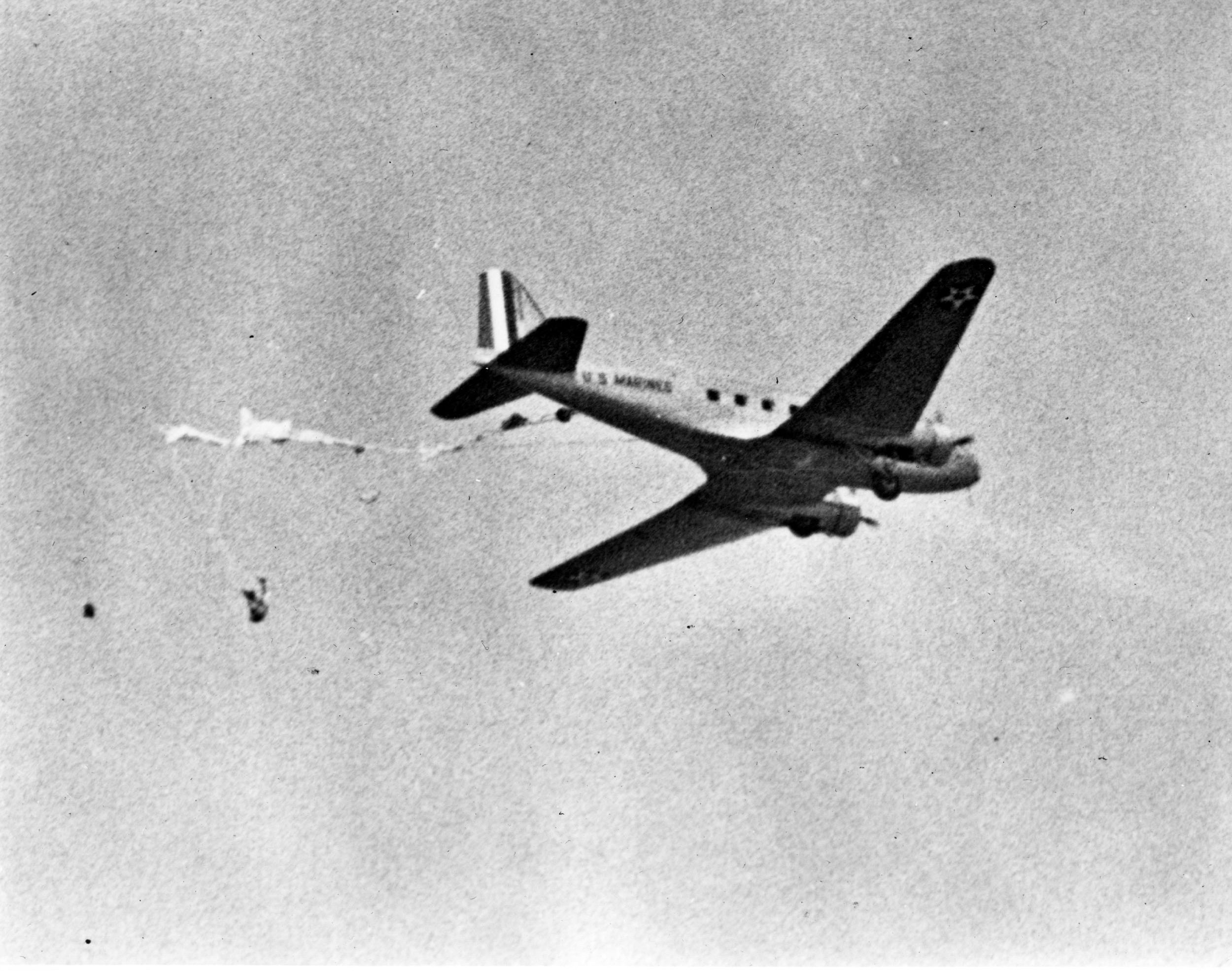
A few seconds later a corpulent, middle-age man, oversize camera in one beefy hand, equipment bag in the other, bursts through the room like a rampaging bull, a slimmer young man with a standard press camera only a stride behind.
The building shakes as they pound down the stairs and once on the street they scoot to a car, open the doors and jump in, younger man at the wheel, big man in the passenger seat who as they dash for the bay fits a telephoto lens to his camera and cranks up the focal plane shutter.1A spring powered cloth curtain with a series of slits of varying widths for exposures up to one-thousandths of a second. With that and the 17-inch Dallmeyer telephoto lens he put in his Auto Graflex, Harry is ready for action.
Seven short blocks down G Street, the last thirty yards in a skid, and even before the motor car stops he leaps to the street, slides to a halt, and fires a shot from the hip. For a moment he stands like a statue: heavy set, middle-age man in blue serge suit and gray felt hat, camera at rest on his belly and only one thought on his mind: had he been quick enough? He lowers the camera and runs for the car. The assistant drives him back to the plant, watches him bolt for the door then heads for the ferry boat landing to catch a ride to North Island to cover the story from there.
The big man en route to the darkroom responds to an editor’s questioning look with an affirmative nod of his head, but alone in the lab, souping the film, he regrets his show of bravado. The plane had been almost out of sight, he had fired a shot from the hip, and now in the darkroom, sweating it out, he is not that sure of success.
The neg is sharp, a perfect exposure, and he breathes a sigh of relief. The image is small, a dot on the frame, but blows up well and makes a good picture – transport and dangling Marine, helmet floating behind – and when he slaps the print on an editor’s desk he’s his competent, cocky old self: Harry Bishop, fast on the draw but getting on. He started a couple of decades ago and wasn’t a spring chicken then.
The man on the desk, phone in his ear, working the story, mouths his thanks and nods his head thus dismissing Harry who waddles back to the darkroom. Because he was out playing newspaperman he has fallen behind in the processing work, the sections need art for tomorrow, there is film to develop and prints to be made and all those pictures for Sunday. Deadly and dull, this processing work, but a vital part of the job.
While souping the film and making the prints his thoughts remain on the trooper and the terrible fix he is in – dangling behind the transport a thousand feet in the air.
How much of that flopping about can he take?
And how the heck did it happen?
* * *
The trouble began when a parachute popped open inside the cabin, yanked a trooper out the door and left him dangling behind. Till then a perfect drill, a precision performance by Company A, a sight to see from the ground: Old Gray Goose2The name Marines applied to the Navy transport used during parachute training at Kearney Mesa, ten miles north of the city, and later at Gillespie Field near El Cajon. plodding along over El Cajon Valley, spewing a stream of troopers who scream and yell their delight as their parachutes blossom and dance in the sky. They are at play in a world of their own, unaware of the mishap back in the cabin that triggered a battle for life.
The trooper would survive his ordeal through courage and pluck and help from his friends; would live to fight in the war just ahead and win promotions and honors in a career that would leave him with fond recollections. And maybe a nightmare or two.
For the mishap that day in the cabin and the battle for life that ensued are the stuff that nightmares are made of. . . .
He stands at the door of the transport in charge of the training jump, his assignment clear in his mind: get the troopers out in good order, drop the packs containing their weapons, and follow them out the door. At his command “hook on!” troopers attach their release straps to a cable the length of the cabin. At “go!” they dive out the door in succession. But while ushering them out of the cabin, something snags his release strap and silk explodes from his pack, is snatched by the wind and whipped back in a stream till caught in the rear landing gear. Yanked from the cabin he sails in space till the parachute cords extend and he’s snapped like a fish on the end of a line. His helmet flies off, his chest straps break and his harness is ripped from his back. But one of his leg straps holds and four unbroken parachute cords wrap around his leg and give him a new lease on life. Spinning and flopping, he dangles behind, unaware of a gash in his arm and rib and vertebrae fractures. Flashes of earth and sky and parachute silk blend in kaleidoscope patterns till the air becomes smooth and the spinning subsides and a cold blast of wind revives him. Things become clear: this isn’t a dream, it’s real. Fear hits hard, not panic. He is young, 23, an all round athlete, a wrestler and gymnast in college; he has jumped before, at least twenty times, he isn’t the type to panic. He has a utility ‘chute on his chest but he can’t crack it now, attached to the plane as he is, the shock would break him half. He feels a tug on his leg; are they trying to pull him back? Hopeless, he knows; not enough troopers left in the plane. Nine went out before him; two and the pilot remain. Two is not enough. Just stay cool, he advises himself, wait for the rescue attempt; the Navy will give it a try. But if it doesn’t work out — at least the insurance is paid. . . .
This is 1941, twenty years after the development of two-way radio systems for aircraft, but because of a skimpy budget the Navy plane is without one, and the pilot, unable to call for help, circles the city while those still aboard try to pull him back. Convinced it can’t be done, the pilot turns for the Navy base across the bay at North Island. He makes some passes over the field before the men on the ground notice the “target tow” trailing behind the transport is in fact a parachute jumper whose lines have caught in the tail. The word is quickly passed. Two Navy flyers, Lieutenant Bill Lowrey and Machinist’s Mate John McCants, glance at each other to make sure their thoughts are in synch, then hop into Lowrey’s biplane, Lowrey at the controls, McCants in the seat behind. As they hunker down in the cockpits a Marine runs up to the plane and hands a knife to McCants who grabs the weapon and waves his thanks as the plane rolls toward the runway.
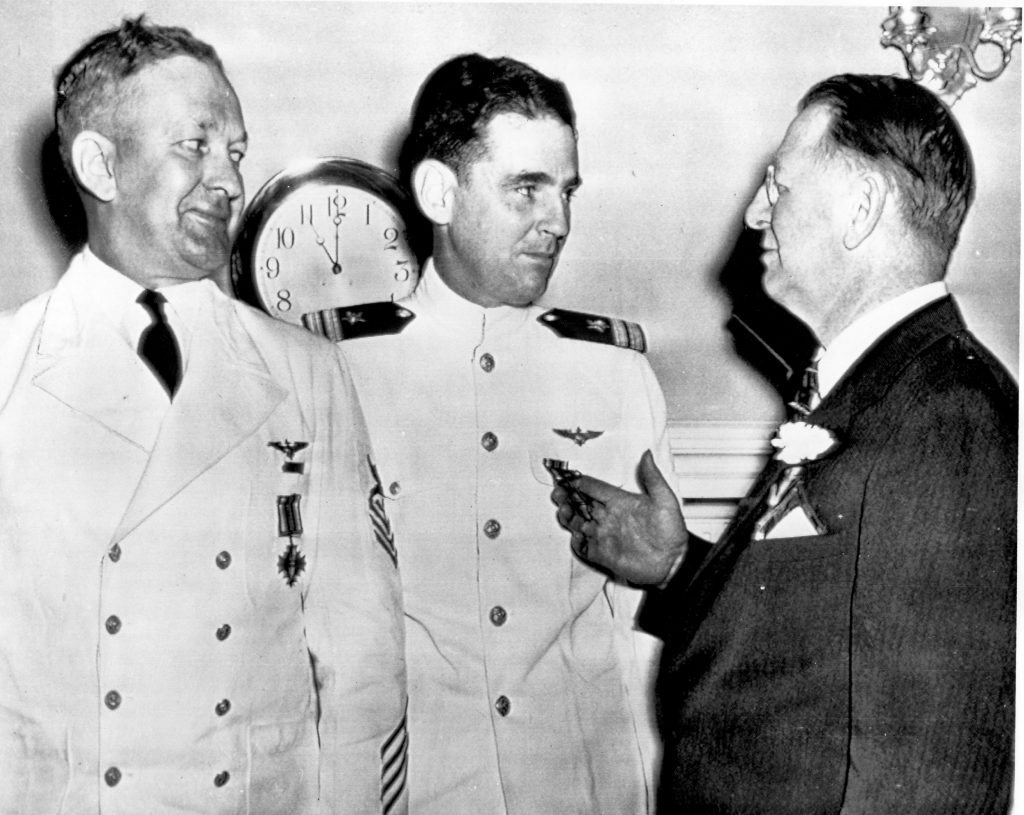
When Lowery catches the transport, he signals his plan to the pilot and receives a nod in return. He puts his aircraft under the trooper and McCants gets ready to grab him. But a gust of wind knocks them off center and the Marine bounces off a wing and is dangling behind again. Lowery eases off to the side, then comes abreast of the transport and offers another solution. He points to the ocean, then to the sky, and the transport pilot agrees: head out to sea and fly a bit higher; look for smoother air. They find it a short time later and start the drill again. Lowery gets into position and McCants grabs hold of the trooper but can’t fit him into the cockpit and they fly along that way, trooper half in and half out, clutching McCants in a bear hug and still attached to the parachute cords. McCants is unable to get to his knife to cut the trooper free. Lowery, seeing the problem, steels himself for the effort and raises the nose an inch at a time till the propeller slices the cords. And nicks the tail of the transport. He throttles back, loses height and is safely out from under. He looks for damage. The prop is doing its job, the Marine is hanging tough, and the transport is plodding along just as if nothing had happened. But missing a chunk of its tail. Another close call for Lowery; he’s had a few before but none as scary as this one. Both planes might have gone down. And diving away as he did, he might have lost the trooper. Intending to catch the transport, he opens the throttle and increases the speed but the steering controls — rudder bar pedals and joy stick — do not respond as requested. He swivels around in the cockpit and grits his teeth again. The shredded parachute cords are tangled in the tail. He pushes hard on the rudder bar pedals, one at a time, starboard and port, and gets a little response; tries the joy stick again and the elevators grudgingly yield. Fine. Only requires some muscle; he can live with sluggish controls. Would never do in a dogfight but will probably get them home. He wobbles up to the transport to show the trooper is free but still in plenty of danger, half in and half out of the cockpit, and hanging on for life. Reading each other’s thoughts, the pilots quickly agree: time to get the hell home. Battling the sluggish controls, Lowrey makes it back to North Island, and, minding the trooper’s plight, touches down with hardly a bump and the transport follows him in. As the planes roll down the runway, hollering, whooping men on the base rush out in body to greet them. The clamor subsides as corpsmen attend to the trooper and take him away on the hospital run, then starts anew, greater than ever, as the men surround the pilots, shake their hands and pound their backs and ask them how they did it. Lowrey tries to explain: it was not a skillful maneuver, the wind had bucked his plane, but no one will listen; he and McCants are heroes and deserve the highest honors.
[Each would receive the Distinguished Flying Cross and each would say that Captain Harold Johnson, who kept the transport steady, thus ensuring success, deserved a medal as well.]
The Evening Tribune crew, facing a difficult deadline, made it with minutes to spare, then spent the rest of the shift casually responding to callers: “sure, we got the story – it’s in the paper tonight.” The Union staff, with additional time, would offer its morning readers a full account with plenty of quotes, sidebar stories, Harry’s picture, and a sketch depicting the rescue. Harry provided the artist, Fred Wilson, with prints of the planes (a Douglas DC2 transport and a Curtiss SOC1 Scout), and a reporter explained the rescue, then both looked over his shoulder to see that he got it right.
They’d wrapped it up soon after; page dummies and copy to composing, pictures and art to engraving, then everything down to the presses. Home and sack for the morning crew; back to the routine for Harry.
They got him out of the darkroom to answer a telephone call; an offer from a Los Angeles radio station to appear on a radio show along with McCants and Lowrey, the airmen to take part in a dramatization, Harry’s bit to follow. Silly, he thought, the airmen were heroes, had risked their necks to save a life. He had taken a picture. True, a pretty good picture, but look how lucky he’d been. The tip came in at just the right time, the traffic was light on the dash to the bay, and the plane was in sight when he jumped from the car, though more than a mile away. He’d aimed at a dot in the sky and happened to get a picture. Appear on a radio show with a couple of genuine heroes? It wouldn’t be right. But they offered him twenty-five dollars, train fare and dinner besides, and he took the train to L.A. And flunked his part in the show. Lowrey and McCants did well but Harry fumbled his lines.
Home in bed by midnight and dead to the world in balmy sleep. Five hours later, sweetly restored, he enters the plant as the street lights give way to the dawn. Peeks in the darkroom, listens with patience and kind understanding to the early man’s tale of woe; checks the log, confirms the report, then rolls up his sleeves and gets started.
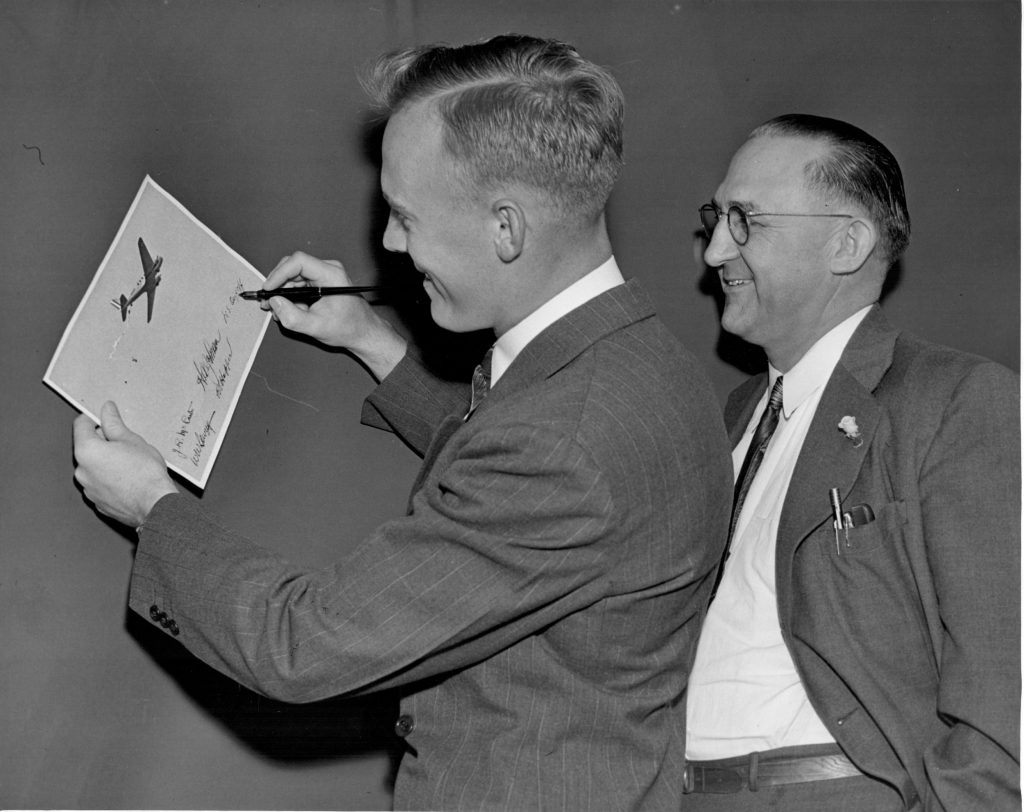
No feet-on-the-desk-coffee-and-doughnut-scan-of-the-papers this morning; the penalty for shirking his duty last night and taking the trip to L.A.
For Harry produces the art for morning and afternoon papers he serves, operated separately under one owner – The Union-Tribune Publishing Company – but rivals nevertheless. While most department heads profess to enjoy a “spectacular” as much as anyone else, they believe it’s the standard stuff for their sections that keeps the newspapers going – and they want it served up on time. They are never surprised when Harry, though part of the management team, rolls out on a fast breaking story like an intern impressing the boss, and it’s O.K. with them, this compulsion of his as long as he delivers on schedule the art their sections require. He does his best to oblige them. All pictures are equally important, he tells them, no matter where they are placed. The P.R. shot for inside the paper is as vital to him, he assures them, as the spectacular he shoots for Page One. They don’t believe him, of course, but they respect the intent of his message.
Today he is finding it hard to get going because of the calls coming in. Great work Harry, you did it again, seems the message of choice, and while it is nice to hear he is too much the old pro to be carried away by the plaudits. Still, he envisions the treatment – MIDAIR RESCUE on top of the page, picture over the fold – and customers storming the news stands. Actually, display is not his concern – as long as they use his picture. As it turns out, the presentations could not have been better: story and art over the fold in the Tribune’s home edition forty five minutes after the rescue. Complete package – detailed account, side bar stories, extra pictures, and Fred Wilson’s drawing – in the Union’s morning editions. Good newspapering, as they say in the business. It certainly had been fun. Getting the call, racing down G Street, spotting the plane, firing a shot, sweating it out in the darkroom, watching the print come up in the tank —
All in all things had worked out; he’d delivered the picture, the Marine3Lt. Walter Osipoff spent six months convalescing, then went back to his unit and began jumping again. He won medals and promotions in the Pacific Theater during World War II and rose to the rank of colonel had survived, the excitement is over and he’s back making prints in the darkroom. At 46, a management type in charge of Photo and Art, a veteran of 21 years, a step or two slower now, he still wants to roll on the big ones. The camera he calls “Old Betsy” (unconscious of his sin), is specially rigged for action shots, loaded and ready to go. So call him on breaking stories; day, night or weekends. Flash his name on a movie screen if you can’t find him anywhere else. Who knows when the big one will pop? Maybe even tomorrow.
Turns out, it was today.