Like other nondescript places that catered to the business crowd at lunch time in downtown San Diego late in 1919 the Bay City Buffet on Fourth Street offered its clients modest appointments, indifferent cuisine, and limited space at the bar. And like others it suffered a loss in business early in 1920 when unwary voters approved the Eighteenth Amendment.
But here it was, one year later, and the little bar on Fourth Street, no added decor, menu as dismal as ever, was doing business as never before. It was known as the friendliest place in town. Of the businessmen who dropped in at noon few seemed anxious to get back to work and some of them never did. There was a modest lull in mid-afternoon but hold your place at the bar when the five o’clock whistle blew.
How to account for its amazing success? One man in town, a federal agent down from L.A., thought he had the answer. The newspapers chided him for wearing a star and shining it every day. They called him “Little Thor” because when the occasion required, as it did this day, he would arm himself with a hatchet. The federal agent was sworn to uphold the law, and having sampled the grape juice served at the little bar on Fourth Street, knew what he had to do. Charles Cass, hatchet in hand, his eye on the large wooden keg before him, raised his arm, took a deep breath, and delivered a mighty blow. Hatchet met wood in an ear-splitting CRACK that prompted loud laughter and shouts of derision from the small but boisterous crowd on the sidewalk outside the bar. Aside from prompting the laughter, the ear-splitting CRACK covered the click of a Speed Graphic camera in the hands of a frail, young man who had covertly snapped the action and intended the follow up shot – grape juice flooding the gutter.
Shoot it and run, that was his plan; don’t get clobbered by Cass. But when a voice in the throng gleefully shouted “Hey Cass, that newspaper guy took your picture” it ruined his hope for success. The agent, who’d been watching the grape juice flow from the shattered keg to the gutter, stiffened as though he’d been shot. He paused for a moment then turned to look for the culprit. When a look of disgust clouded his face it was clear to all he had found him. He shook his head in disbelief. He had encountered this lad before; had thought he had taught him a lesson –
O.K. my boy, his look seemed to say, if that’s the way you want it –
Short in stature but powerfully built, his face a sinister mask, he approached the youth in the stealthy glide of a tiger. Determined to stand his ground the youth braced himself for the onslaught. The action was swift and decisive. A snatch, a struggle, over in seconds, and the agent was holding the camera. Then, a tight, little smile on his smooth shaven face, he removed the 4-by-5 holder and exposed the film to the light. After handing the camera back he turned to the crowd and said: “I can’t stop reporters from writing their stories but it will take a mighty fast man to get my picture while I’m still alive – they just want to make me look foolish.”
The youngster, fighting back tears, returned to the newspaper plant and reported the outrage to Harry. Harry, a “root beer and buttermilk man who rarely touched the hard stuff,” had personally favored the Eighteenth Amendment, the measure called Prohibition, and could honestly say his feud with Cass, the man who enforced the provisions of the Volstead Act in the city – or tried to – was over Cass’ reluctance to have his picture taken, not his right to limit the drinking of booze.
Cass was one of the 1,500 agents hired after the Eighteenth Amendment had been ratified (Rhode Island and Connecticut opposing), the Volstead Act enacted, and an enforcement program created by Congress. The agents, paid an average of $2,000 a year, were positioned throughout the country to prevent the making, selling, or drinking of anything stronger than near-beer, a concoction no real boozer would tolerate and few social drinkers would be likely to try. Chaos and scandal followed in a period as corrupt and degrading as any in U.S. history – and it lasted thirteen years. Riddled with loopholes and flaws and stingy with funds for enforcement, the measure was doomed from the start. Overmatched agents were unable to cope with the rum runners, bootleggers, and gangsters who exploited the ready-made market. Illegal distilleries and breweries sprang up. Rum running boats prowled off both coasts. Gangs took charge of the cities, divided the turf and jacked up the price of booze. Pay or get bombed out of business, that was the message they sent. Gang lords and booze barons made millions. Some of the loot went to political types and some of it went to lawmen. What evolved was a violent, crime ridden nation far removed from the booze-free Utopia prohibitionists had envisioned.
Though the unworkable laws were trashed in 1933 the mob was firmly entrenched in the cities and ready to exploit the growing interest in illegal drugs.
As previously mentioned Harry had no personal quarrel with Prohibition but had plenty of doubts it would work. While a musician in a cabaret band he’d observed a good many people who had access to liquor, and while there were some who retained their composure while drinking the stuff there were others unable to curb their excitement while sniffing the cork from a bottle of wine.
He was in San Francisco on January 6, 1920, when Prohibition went into effect. He had served a brief term in the Army and was having moderate success as a musician while trying to forget his failure as a reporter for the San Diego Sun. He’d become a family man who was reluctant to discuss with his wife and adopted son a day in the life of a cabaret musician when it happened to include a shooting or brawl as it frequently did. When he finally realized what his wife knew all along, that life as a third rate musician was not the life for him, they returned to San Diego with the idea that he would become a professional photographer even if it meant living off her investment earnings until he made the grade. He had hired on at a camera shop for a small salary to gain experience, and after he’d learned all phases of photography and darkroom procedures had started in on his own. He soon became known as a competent pro who would take studio shots of an infant or go up in a plane for a picture – whatever the occasion required. The Union-Tribune Publishing Company took notice of his talent and asked him to join the photo staff that served its two newspapers. Harry of course obliged – he’d set his sights on the job. When he reported for work in the spring of 1921, Cass had been in town for more than a year, had been moderately active at first but lately had picked up the pace. For $40 a week and whatever else had motivated him he’d sworn to enforce the law, and this he did (when he finally got going) with dedication that gained him respect but methods that earned him the hiss of a city. Merchants complained that he spilled harmless grape juice into the gutter after proclaiming it loaded with booze. They said he would enter an establishment and without displaying a search warrant use an illegal device to test the alcohol content of the beverage being offered for sale.
The newspapers had fun in covering Cass but a fair minded person would have to say he’d been roughly treated. Readers could infer from cartoons, headlines and stories that Cass had serious mental problems.
Left out of the fun was the photo department. Cass made known from the beginning he detested photographers and would resist with force efforts to take his picture. A resolute type with very quick feet and a precision gear in his brain, he planned his strikes, hit his targets, gathered the evidence, and was gone before a photographer could get to the scene. The few confrontations between Cass and a cameraman ended without a picture. Attempts by the editors to crack his security using an inside source who would tip them in advance of a raid were unsuccessful. As top photographer in a photo department short of staff and serving two newspapers, Harry was reluctant to free himself and chase after Cass. He tried to arrange a conference, believing that with a calm and reasoning approach, he could convince Cass of the newspaper’s right to photograph him spilling grape juice into the gutter. He asked a police officer friend to arrange a conference with Cass, and the officer agreed to try. But word came back that Cass would rather lose a pint of blood than meet with Harry Bishop. The photo department had no alternative but to release a man from day-to-day duties and assign him to follow the man.
A picture sneaked of Cass (by one of two photographers who double teamed him) at the police station a few days later and used in the morning paper failed to satisfy Harry. A static head-on shot of Cass, good for the files but not what he had in mind. Furthermore, Cass had committed the crime of snatching the camera and exposing the film of one of the photographers. Though it was the wrong photographer (the shot was made by the other) the crime could not be ignored. Harry wanted Cass in action and he wanted to make sure the agent knew Harry Bishop was taking his picture, not the unseasoned apprentice he’d bullied for doing his job.
“Then we’ll find out if there is going to be any more of this camera snatching stuff,” he told his young companion.
The second assault (on the same young photographer, outside the Bay City Buffet) followed.
Until then, Harry had felt compassion for the agent because of the futility of his task and the way he had been ridiculed in newspapers. To him the stories, while mildly amusing, had seemed overdone and unfair. But now – after this latest assault – he decided to put his feelings aside and go after “the little scrub.” He vowed he would get a picture of Cass in action or quit the business. He gave the youth a pat on the back and said, “We’ll get him, son, I have a plan.”
Harry’s plan, the age-old bait and switch, required his presence at the scene of the raid as the man to get the picture. His partner would call to Cass to get his attention, then pretend he had fired a shot. Cass, if true to form, would grab the camera and expose the film and Harry would catch him on film committing the crime.
“A Page One picture,” he told the youth.
The plan required the assistance of a police officer friend of Harry’s who had just started working with Cass. Harry asked him to call in advance of the next raid and the officer said he would. But at the last minute the officer chose devotion to duty over complicity with a newsman and Cass had departed by the time Harry and his partner arrived.
Several days later a reporter covering Cass called and said he had learned of a raid set for that day at The Theater Buffet on Second Avenue. Since the place was across the street, just a few steps from the newspaper building, it seemed like a challenge to Harry. He summoned the young photographer and as they walked toward the Theater Buffet they went over the plan again.
“Get his attention,” said Harry. “Make sure he thinks you’re trying to take his picture. I’ll lose myself in the crowd.”
They arrived to find twenty or thirty people milling about near the entrance. Cass was inside, they were told. He’d entered the place flashing what looked like a warrant; he looked as determined as ever.
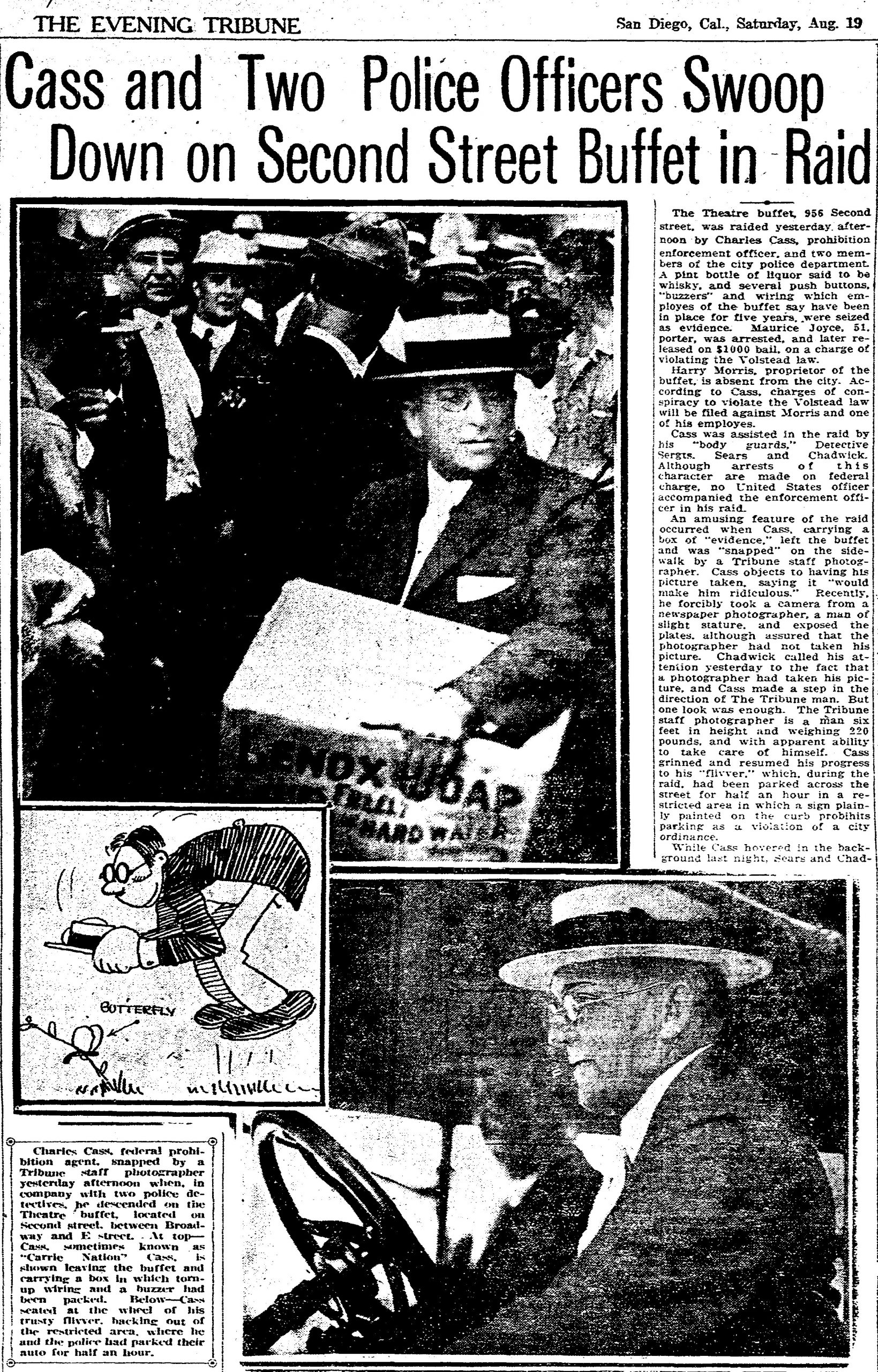
Some in the crowd, aware of his feeling toward newsmen and spotting a wide shouldered man with a camera alongside the skinny apprentice previously accosted by Cass, exchanged knowing smiles that said to each other this might turn out to be fun.
A patron slipped out with a first hand report of the proceedings inside. Cass was confiscating a bottle of whiskey and a warning system comprised of push button buzzers and wires, and was placing them in a box.
The warning system, not to mention the liquor, implied a measure of guilt but was of no concern to Harry. He wanted a picture of the agent in action, justifiable raid or not.
Harry glanced at his companion who stood a few feet to his right, waiting nervously, expecting to have his camera yanked from his hands again. He’d told Harry he would resist as best he could out of pride but knew he was no match for the powerful Cass.
There was a sudden rise in the level of crowd noise and a shifting of positions to clear the entrance, and Cass, impeccable in business suit, white shirt, dark tie, and straw hat, his face as impassive as ever, came striding out. In his arms was a large box presumably containing the evidence. Harry’s partner swallowed hard, moved forward displaying his camera, and shouted “Hey Cass – I’m over here!”
The agent looked up, clenched his teeth and, cold eyes on the youth, strode toward him without hesitation. His intention was clear to all in the crowd; a confrontation inevitable. Onlookers shifted positions for a view of the impending encounter. This provided an opening for Harry who had a clear shot at the agent he considered too good to miss: Cass holding the box of evidence. He triggered his camera. Cass, unaware his picture had been taken by Harry, handed the box to an assistant, and resumed his walk toward the youth. He was one step away when Harry decided he couldn’t allow his companion to suffer another embarrassment by having his camera ripped from his hands again – he had a good enough picture. In a voice that might have spilled booze from the grape juice glasses inside the Theater Buffet, he bellowed, “Hold it, Cass!”
When the crowd noise dwindled and died, he said in his normal voice “I took your picture, not the kid – so what are you going to do about it?”
Onlookers, sensing a new confrontation, shifted again, this time to provide the agent, should he desire, direct access to Harry who stood like a contestant at the OK Corral awaiting the inevitable showdown.
Cass looked, saw a man with wide shoulders and a large frame who was at least six feet tall and weighed well over 200 pounds. Whether that deterred him, no one knows for sure. He smiled slightly, shrugged his shoulders, turned his back and walked away. He was followed by Harry who took another shot of the agent as he sat at the wheel of his car staring blankly ahead.
In recounting the incident Harry said he saw no fear in Cass.
“He was a fighter,” he said, “but he was also a realist. He knew what would have happened if he tried something funny.”
What would have happened?
“I’d have bounced the camera off his head.”
After a pause he explained: “It wasn’t ‘Old Betsy.’ It was one of my older cameras.”