The speedboat, slender and slick and throbbing with power, is racing over the bay with Harry in the stern facing a group of youngsters stunting on aquaplane boards the craft has under tow. He is kneeling on his hat and his elbows are braced on the back of the boat to keep the camera steady, but no matter how hard he tries he can’t get the timing right. If he isn’t riding a crest he’s plunging into a trough. His clothes are wet, he’s chilled to the bone, his knees are taking a beating, and he’s blowing shot after shot. I must keep trying, he tells himself, but boy, this pounding is murder – don’t know how much more I can take. . . .
He had parked the car just north of the Broadway Pier, walked to the head of the stairs and looked down at the small boat landing. He was early as usual and as he suspected the speedboat hadn’t arrived. Rather than wait on the damp, misty landing he decided to stay on the dock. The boat would be coming from Coronado; he would see it approach in time to get down to the landing and meet it. He went back to the car, got his camera and gear and placed them near the head of the stairs. Then, foot on berm, elbow on knee, chin on fist, he took in the waterfront scene: passenger liner at the end of the pier, freighters on either side, dock hands working the cranes, excursion boat skirting the bay, Navy ships piercing the mist in the water off North Island.
His thoughts went back in time to how it looked when he was a boy, new in town, fourteen years before. Except for a jetty built at the entrance, and piers and wharves, and landing docks haphazardly scattered about, the harbor was still in its natural state, marred by unadorned mud flats, remnants of waterfront shacks, and a buildup of sand in the channel. (More than one ship had foundered on the “middleground shoal,” old timers had mentioned to Harry.)
Still, to a boy of fifteen who’d never seen an ocean or bay, the waterfront was new and exciting, and recalling the fun he’d had exploring the rim of the bay he experienced a touch of nostalgia. Of very short duration. For Harry is now 29, a family man whose precious career is linked to the growth of the city. He favors orderly progress; has no quarrel at all with the people back then who’d decided to beef up the harbor.
They decided in 1911, knowing the Panama Canal, under construction since 1906 and due for completion in three or four years, would shorten the sea lanes between the two coasts by 8,000 miles or so, and ships passing through the canal and heading on up the coast would stop in San Diego – if they could be properly handled. If not, they would sail on by to the big city ports to the north, Los Angeles and San Francisco.
An extensive dredging program and a big municipal pier with plenty of warehouse space would give the city a chance to become a prominent seaport, city officials were thinking, and if completed in time would tie in with the big exposition planned by the city to honor the Panama Canal and get the city some needed exposure.
The city had been knocked to its knees in the crash of 1880 but had pulled itself together, had risen in stature and standing, and through realignment of districts had gained representation in Congress, thus more political clout, and new appropriations for harbor improvement could be had for the asking.
This was something new. Generally in the past, the colossuses to the north, Los Angeles and San Francisco, had gotten all the handouts and had become important seaports while San Diego’s harbor stayed largely unimproved causing larger ocean vessels to enter at their peril. (When the Great White Fleet1A group of US Navy battleships that travelled around the world to project United States naval power made its appearance in 1908, only the smaller ships came into the harbor, the larger ones stayed anchored at sea.)
The Nolen Plan, keyed to aesthetics and under discussion for years (it called for an open bay front with a plaza of government buildings and a system of public parks) was shunted aside in favor of commerce and trade, and work was begun on the pier.
A railroad line to Yuma, promised by John D. Spreckles, would connect with Southern Pacific and provide a link to the East, and the projects when finally completed would help establish the city as a southwest center for trade. That was the thinking then.
Now, in 1924, the Panama Canal has been opened, the harbor has been dredged, the Broadway Pier has been built, and the B Street Pier is under construction. And though the ships involved in world trade continue to bypass the city, and the railroad line to Yuma promised by Mr. Spreckles is not of significant help (it got only as far as El Centro) there is plenty of action inside the bay despite the efforts that failed. The Navy has decided to expand at North Island and is building a major base; the fishing fleet continues to thrive, passenger liners make regular calls, and shipping tonnage is up, though intracoastal in nature.
And more improvements are planned, improvements questioned by some, including a flippant reporter who, assessing a story regarding a plea for additional funds for the harbor, asked aloud in the newsroom, “why the need for improvements? Our waterfront is already as squalid as those on either coast.”
Standing on the dock, recalling the cynic’s remark, Harry said to himself, the guy is probably right. Though he hadn’t noticed before, no question the waterfront is messy: creosote blackened pilings, old rubber tires nailed to docks, refuse afloat in the water, crusty old rust bucket freighters, and that B Street Pier a block to the north – an ugly protrusion into the bay, half finished as it was. But that’s what waterfronts are, Harry said to himself; that’s the way they should be.
The craft crept up to the landing. Harry, struck by its splendor and size, could only stand and stare. A late model speedboat, slender and regal with eloquent lines, ornate appointments, and polished brass fittings, it seemed out of place in these scruffy surroundings, hobnobbing with working class craft – fishing skiffs, dinghies, and rowboats. He’d seen it before, out in the bay, and impressive as it looked from a distance, up close it dazzled the eye. All that varnish and brass – cushioned bench covered with leather – polished mahogany housing the engine – windshield framed in glossy white metal.
He’d bet it had plenty of speed – look at those racy lines – and look how it sits in the water – unlike its skittish companions, it’s hardly moving a muscle.
The public relations man had come over from Coronado to help him with the assignment: publicity pictures of an exciting new sport catching on in the bay. Standing next to the pilot who was keeping the engine purring, he’d waved a greeting to Harry who had slowly come out of his trance to notice the PR guy, and when he finally stepped into the craft – after wiping his feet on the deck – his host who was suitably clad, winced at Harry’s attire – blue serge suit and gray felt hat – and said in mild reproof, “I warned you, Harry, it’s choppy out there, you’re going to get wet sure as hell.” Then he buttoned the neck of his waterproof jacket and breathed a sigh for his friend.
“I didn’t have time to change,” said Harry, hiding the fact that his wardrobe contained nothing to fit the occasion – no windbreakers, jackets or rain wear. Throw out the standard go-to-work-stuff and Harry’s closet was bare. He’d gone completely standard since quitting the cabaret band.
He did suspect he might get wet sitting in back of a boat pounding around in the bay while aiming his camera at adventurous kids on aquaplane boards – that’s why he wore his second best suit. So what if he caught some spray? What’s a little discomfort as long as he gets the pictures?
“Where are the kids with the boards?” he’d asked.
“We pick them up at the beach.”
After picking them up at the beach and getting them under tow he’d discovered the assignment was tough, tougher than he had expected – there in back of the boat, kneeling on his hat, trying to get his timing down – and blowing shot after shot.
He finally developed a system: shoot on the downward plunge, just before the impact. Tough on the knees (which, by the way, seemed to be getting numb), but now that he’s able to time his shots he is sure he is getting good pictures. A couple more clicks of the shutter, he’ll wrap it up, go back to the lab and start souping the stuff. That is, if he’s able to walk.
The pictures will go on a special page promoting the city across the bay they call “the enchanted island.” The PR guy whose mission in life is to sell its year-round attractions will send copies to cities back East where such pleasures are often denied.
Publicity work, Harry knows, but he’ll do the best he can – as he does on every assignment. After all – and none know it better – promoting the city is part of the job. . . .
When Harry was hired by the Union-Tribune Publishing Company in 1921, he was told that in addition to his regular duties he should flood the country with pictures that demonstrate the dynamic nature of the San Diego area (including Coronado, most of which was owned by the publisher) as well as its cultural splendors. He never forgot the message:
“Press photography is coming into its own, Harry . . . it’s a golden opportunity to make the area known through your pictures. Show the shivering people back East what they are missing. Let them see us enjoying our year-round sunshine, frolicking at the beaches, romping in the surf, sailing on the bay.”
The briefing was conducted by James A. MacMullen, general manager then, who, convinced he had in Harry not only a man with talent but one who could handle the workload that had killed the guy he’d succeeded, started him high on the ladder: thirty dollars a week. Harry, who had failed as a reporter and had aborted a music career, had made a name for himself as a competent, hard working freelance photographer; a daredevil who went up for aerial pictures and walked away from the landings or limped away from the wreckage, indifferent in either case.
While the instructions were delivered by MacMullen, “a grand old man of the fourth estate” (whose frolicking days were over by then), Harry knew where they started: in the office of John D. Spreckles, the man who owned the papers. Spreckles, who with his brother Adolph, had a heavy stake in the growth of the city and no qualms in combining commercial boosterism with his perception of responsible journalism.
The brothers had, in the thirty years they’d been in town, acquired a bank, the bay ferry system, the electric street car company, and part of the city of Coronado including a luxury hotel and a tent city resort. They owned (among other things) water, light, fuel, and power companies, and the ferry boats that ran in the bay between San Diego and Coronado. And by buying the papers they had covered their bets.
Biggest plunge had been the building of the San Diego & Arizona railroad line 140 miles east to El Centro, California. As stated before, he fell short of his original goal, Yuma, Arizona. Proposed in 1906 as a four million dollar solution to a dwindling population caused by the collapse of the ’80s land boom, it would connect with Southern Pacific, provide a link to the East, and spark the influx that would help sustain their investments. But there was trouble from the start: construction through mountains and gorges into and out of Mexico, financial disputes with Southern Pacific, a secret partner; revolutions in Mexico, the war in Europe, and the floods of 1916. And if twelve years and eighteen million dollars after the start, Mr. Spreckles took an overly vicious swing at the golden spike that signaled the project’s completion, you wouldn’t have blamed him a bit. The link to the East wound up as a branch line, the city never became a major terminus, and Southern Pacific finally took over the line.
As previously mentioned, the order to help promote the city never bothered Harry, whose desires were just as personal as those of the Spreckles if not as grandiose. A steady job, a worthwhile career, and the chance to erase the stigma of previous failures were all he wanted in life. If it meant extra hours on special assignments, overtime work in the darkroom, disruption of holiday plans – why that’s the way it would be. By later standards it was an incredible workload, but to Harry it meant fulfillment if he could handle it well, and he did. He produced good, professional pictures for all the sections of the papers he served, and in addition, spent extra hours shooting for his photo service connections – (P&A Photos in the early years, Acme Pictures later, and finally Associated Press) – the publicity pictures the people back East were supposedly panting for: bathers frolicking at the beach or challenging the roaring surf, stuntmen diving from low flying planes –
And young people riding on aquaplane boards…
Three men and two women, all experts at the exciting new sport, were stunting for Harry’s camera that day in July of 1924. They were riding on three boards behind the power boat occupied by the pilot, Harry, and the Coronado Beach Company PR man. After they had shown him every stunt they knew and some they had contrived on the spot, Harry got off his knees and signaled the boatman to go back to the dock. The boat pilot had started to comply when Harry noticed a Navy seaplane that had made several passes high above them now was making another. The three men in the plane seemed interested in the sport. Inspired, Harry made a sweeping motion with his arm, directing the plane pilot to fly low over the boards and have his picture taken.
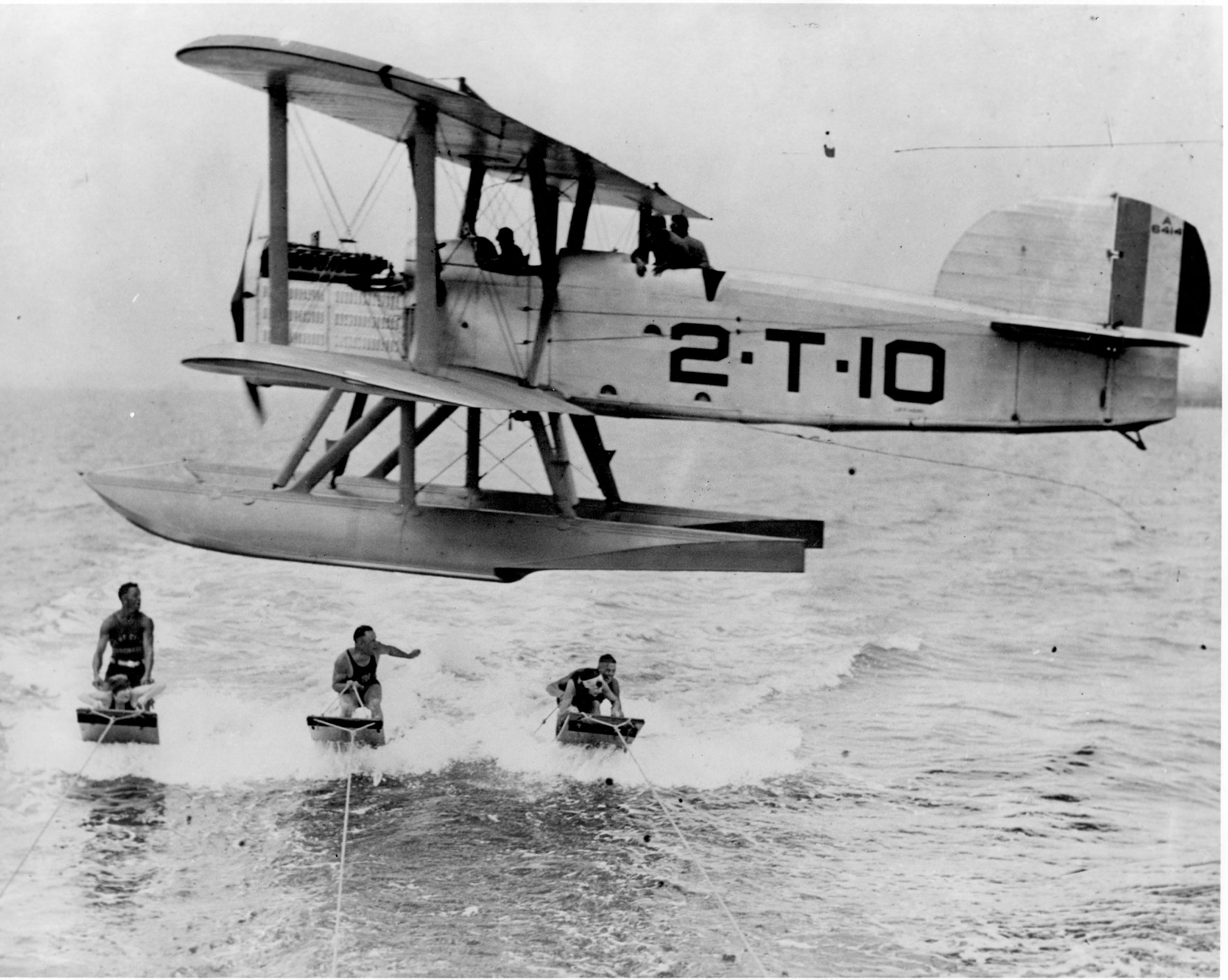
“You’ll get him in trouble,” the PR man shouted over the roar of the motor.
“I don’t think he saw me,” Harry yelled back.
“You made it plain enough,” was the response of his anxious companion.
“He wouldn’t do it anyway,” Harry said, more to himself than to the worried PR man, and began to put his equipment away.
The unmistakable sound of a diving plane far to the right, and the sight of it leveling off a few feet above the water in an approach that would take it directly above the kids on the boards told Harry he’d misjudged the Navy pilot. The guy had the stuff heroes are made of, a fine, upstanding lad. No question.
He couldn’t bring himself to drop to his knees again – the numbness had worn off and he was feeling the pain – so he remained on the seat, anchored his feet to the sides of the boat, raised the camera, caught the approaching plane in his finder and panned along till it was almost over the stunters; then with perfect timing (and luck on the downward plunge) he triggered the shutter, and a few seconds later, flat on his back on the floor of the boat, blasted there by the propwash, he told himself it should be a pretty good picture –
But why was the PR guy screaming? He pulled himself up on the seat, wiped off his camera and stuffed it in the equipment bag. He looked back and saw the reason for the panic. The kids had fallen into the bay and were clinging to their aquaplane boards; his friend had yelled to the boat pilot to “get back there as fast as you can – we have to rescue those people.” The pilot had turned the craft around and was now approaching the youngsters. Harry counted heads: one, two, three, four – where the heck was Five? There he was, behind Number Three. Harry was satisfied; the kids had survived, no one was hurt and he probably had a good picture. The boat was brought to a halt and Harry, who’d abandoned the thought of shooting the kids while they were still in the water – the PR guy would have screamed – helped pull them back in the craft. Getting the boards was a problem and the craft was a bit overloaded but would make it back to shore.
“You probably got the plane pilot in trouble,” the PR man yelled to Harry over the roar of the engine as they hustled back to the shore. Harry misunderstood.
“No trouble at all,” he yelled, “as long as I got the picture.”
The picture, distributed by P & A Photos, got good play in much of the nation’s press, Harry’s clipping service showed, but was buried in the local page promoting Coronado.
Harry learned later that the Navy pilot had been reprimanded for taking part in a publicity scheme that endangered the lives of civilians. Harry’s source, a reporter, said the flyer was grounded pending a review of his status in the Navy’s flight program. He said the pilot was highly regarded, had a spotless record, and would probably beat the rap, but a report had been sent to the editor’s office, “so Harry, you better get ready; it’s going to hit the fan.”
When asked to explain why he had lured a Navy pilot into a dangerous procedure merely to get a picture Harry said the Navy should be proud of the pilot, a man with spirit and daring.
The editor was silent.
“Besides,” said Harry, “no one was in danger. That plane was a good fifteen feet over the heads of the kids.”
“Fifteen feet?” the editor said, raising his voice a notch and pointing to the picture lying face up on his desk.
“Take another look. If that’s fifteen feet, I’ll eat my hat.”
They studied the picture together.
“OK,” said Harry, “make it ten.”