He had spent the day taking pictures. Now he was in the dark room souping film and making prints for the morning and afternoon papers. Another twelve-hour day. Nothing new for Harry. It’s the way it was. Undermanned photo department, no newspaper guild, no overtime pay; just work as long as it takes. That was Harry’s approach and it was widely known and accepted, and so when an editor called and playfully chirped, “Harry! You’re working late,” he could think of no response (though he thought of a couple later) and the editor’s joke fell flat. After a pause the editor said, “Ganna Walska is coming to town.”
“Who?”
“Ganna Walska, the famous opera star. She’s married to Harold Fowler McCormick, son of the guy who invented the reaper.” The editor said McCormick had been in town for a week as point man. He had leased a house in Coronado and installed a crew of servants to be ready for Walska’s arrival. Then he’d caught a train to join her somewhere up the line. She had been on a recital tour and was en route from Kansas City. He’d be with her when she got off the train at Santa Fe Station.
“Get out your running shoes, Harry, these people have been dodging shooters back East for months. It’s up to you to get a picture of them together; show the big city guys how it’s done.”
Harry smelled a bonus. If this was “the son of the guy who invented the reaper” the photo service in town would certainly want a picture. They would send copies all over the country.
Harry, though behind in his reading on business tycoons, suspected the McCormick whose father invented the reaper would be getting checks on a regular basis from International Harvester. This alone would make him a target.
As for opera stars, his knowledge of music had peaked back in his cabaret days and he’d never heard of Ganna Walska. He went back to work unaware of the fuss the eastern papers were making over McCormick and Walska….
He was a Chicago McCormick who’d divorced Edith Rockefeller to become the fourth husband of his prima donna protégé, Ganna Walska. She was a lyric soprano hammered by critics who said it was her benefactor’s influence, not her talent, that was pushing her up the ladder. Throw in a secret operation “to restore wasting tissues” — (McCormick’s. Ganna’s seemed O.K.) and you have what any windy city newspaper in the 1920s would call solid front page material.
McCormick had married Edith Rockefeller, spunkiest daughter of John D. Rockefeller, in 1895. Early in their married life they were looked upon as an attractive couple heavily involved in civic and social affairs and at the top of the list of contributors to charities and cultural enterprises in Chicago, the McCormick family’s stomping grounds. When Edith established herself as the absolute center of Chicago social life, she made it clear she was Edith ROCKEFELLER McCormick, not just a social butterfly married to a minor tycoon in the West. Her unorthodox style of entertaining amused some of her guests but startled others and led to newspaper stories that referred to her as eccentric and unpredictable until such time as “wacky” became the adjective of choice. By 1918 the marriage seemed to have run its course. Edith was studying psychotherapy under Dr. Carl Jung in Switzerland while McCormick was zeroing in on Ganna — or as a newspaper said “showering her with attention” while following her on the recital circuit.
Ganna, born in Poland in 1883, studied music in Europe and America, and though she made her debut in New York with Enrico Caruso, celebrated tenor of the day, failed to impress the critics. Despite the bad reviews McCormick, president of the Chicago Opera Company and also biggest contributor, thought he saw talent in Ganna, but when he took her home to Chicago and suggested to opera officials there she be given a starring role he ran into stiff opposition. His heavy handed attempts to place her center stage were stoutly resisted and a bitter battle ensued. But, as sometimes happens, wealth, power and influence won the day and a performance date was set. When Ganna failed to show, the consensus was she had choked under the pressure of having to prove it was her voice and not McCormick’s influence that was placing her name in lights.
McCormick’s obsession with Ganna, his feud with the opera company and Edith’s trips to Switzerland led to speculation in newspaper gossip columns that divorce was imminent and would follow the one in the works by Ganna and Husband Number Three.
The McCormicks, their marriage falling apart, withdrew as guarantors of the opera company during the 1921-22 season but agreed to continue financial support. (The company struggled on for another year before it folded.)
Edith Rockefeller-McCormick’s divorce was obtained December 28, 1921, and on August 12, 1922, McCormick and Ganna were married in a six-minute ceremony in Paris, France, performed on short notice after resident requirements had been waived and McCormick had contributed to charities for the poor. Sometime before the wedding McCormick tried to keep secret an operation the New York Times said was to “restore wasting tissue” and less discreet publications said was a sex gland transplant.
Hounded by reporters, stalked by photographers, roasted by columnists, it’s little wonder the diva and her latest husband had wearied of the big city press and had fled the metropolis.
Here, in San Diego, a sleepy little town far from the wicked eastern press, they would find the privacy they had long desired. They would put it all behind them knowing they’d escaped the vulgar reporters who’d made their life so miserable. And if they thought they’d be safe from obnoxious photographers you wouldn’t have blamed them. They never heard of Harry Bishop.
In San Diego, you don’t pray for good weather, it’s automatic, and Harry was not worried his subjects would be under umbrellas on this day, March 8, 1923. He had a hunch Ganna would arrive as scheduled and that she and McCormick would anticipate a small press turnout and little if any harassment. Many celebrities before them had made the same mistake. As for Harry, he was ready to harass if necessary. He’d been briefed by a reporter, had scanned the clips, and now possessed the facts. Chances for a bonus were better than ever — assuming he got a good picture.
He chose to forgo the flash gun. Preparing magnesium explosions took time. And if what the desk man had said was true and these people were camera shy and too quick for the shooters back East, they’d be gone before he was ready. On a bright, sunny day like today, he could leave the flash gun behind, use natural light and get off a lot more shots. He’d have to open the lens and shoot at a slower speed, which he could do if he held the camera steady.
He went to the train station well in advance of the arrival time, accompanied by a young society reporter about to experience the thrill of being snubbed by famous people. He ducked into the station to check the schedule — due in ten minutes, he saw — while the reporter joined the other reporters huddling on the platform exchanging irrelevant tidbits. Those who had done their homework would be guarding their secrets while taking part in the chit chat; those who hadn’t would be looking for new information. When Harry came out of the station he decided against joining the happy talk; he’d skip the banter and jokes and keep to himself, check his equipment and get mentally prepared for the challenge.
He had his regular Speed Graphic instead of “Old Betsy” and that meant he’d be pulling slides and swapping film holders and, because it was a slow procedure, probably missing shots. He almost wished he’d brought “Old Betsy” instead. He’d rigged that ancient Auto Graflex so that he could move film holders within the leather pouch atop its body and pop off his shots a bit faster. But “Old Betsy” was too big and bulky for an assignment like this that might require footwork. These people were said to be experts at dodging the press and he might have to chase them down to get the perfect shot.
A train whistle sounded in the distance, someone shouted “there it is” and the reporters turned to look at the approaching mass of iron. They watched it slow to a crawl, belch a final cloud of steam, enter the platform area, fake a stop, grind to a halt and stagger the passengers standing in line ready to disembark. Then it gave a final lurch and staggered them once again. On the platform, a pause as the search for the couple began, then a flurry of excitement as someone pointed and shouted “there they are!” and led the charge toward Ganna and McCormick who were legging it for the side entrance to the station. Not ready to make his presence known to the camera shy couple, Harry kept his distance. But there was no mistaking the lady — handsome, poised and erect — and her husband, quite a bit older and bent but doing his best to keep up with the hard charging diva.
The reporters had overtaken the couple, he saw, and now they would be firing their questions, hoping, as reporters do, to induce an unfortunate comment that would provide a lively lead. They had veered in his direction and now he was ahead of the group, backing off, awaiting his chance for a decent shot. He couldn’t hear the questions but it was obvious that Ganna and McCormick were not responding other than to smile and shake their heads. He had expected them to stop for a moment or two if only to utter a few pleasantries, say “no comment” to the impertinent reporters and then move on. The way things were going it might be impossible to fire off a shot with any chance of success and he began to feel uneasy. He knew he would get a picture, but it might have to be on the run. He slowed down to let the couple get closer, and when they did he could see he had another problem: Ganna was wearing a veil — and the way she was striding, the look her in her eye, the thrust of her jaw, told him she wouldn’t stop, not if he pulled a gun. Maybe later — if she ever slowed down — he could get close enough to reason with her, talk her into a pose. One thing, veil or no veil, she was a handsome woman who knew how to dress: gray shoes, matching skirt and jacket, and a simple hat, not one of those big, floppy things that most of the female celebrities thought they had to wear. Very impressive. Grace would have approved.
Staying on the move, he snapped off a couple of shots but knew there would be nothing worthwhile on the film — Ganna had turned her head each time he’d raised his camera and even if she hadn’t, there was still that lousy veil.
The reporters continued to question the couple as the procession cut a path through a swarm of gawking onlookers. Harry was close enough to hear the questions now, and some of them indeed were impertinent. Repetitive too and he couldn’t have blamed the couple for declining to answer.
I”m sorry,” she kept saying, “I have nothing to say, nothing at all.”
Ganna and McCormick slackened their pace as they approached the side entrance to the train station and Harry decided it was time to assert himself. He fell in step with Ganna and asked if he could “have a minute of your time to take a picture that would be worthy of you and Mr. McCormick.” Her answer — after an icy stare — was to pick up the pace. The snub aside, it seemed a bit hard on McCormick who was red in the face and gasping for breath. Whatever their destination, thought Harry, he’s bound to fade in the stretch.
He decided to take a short cut to the patio in front of the station — no doubt in his mind they were headed that way — and get ready to make a stand.
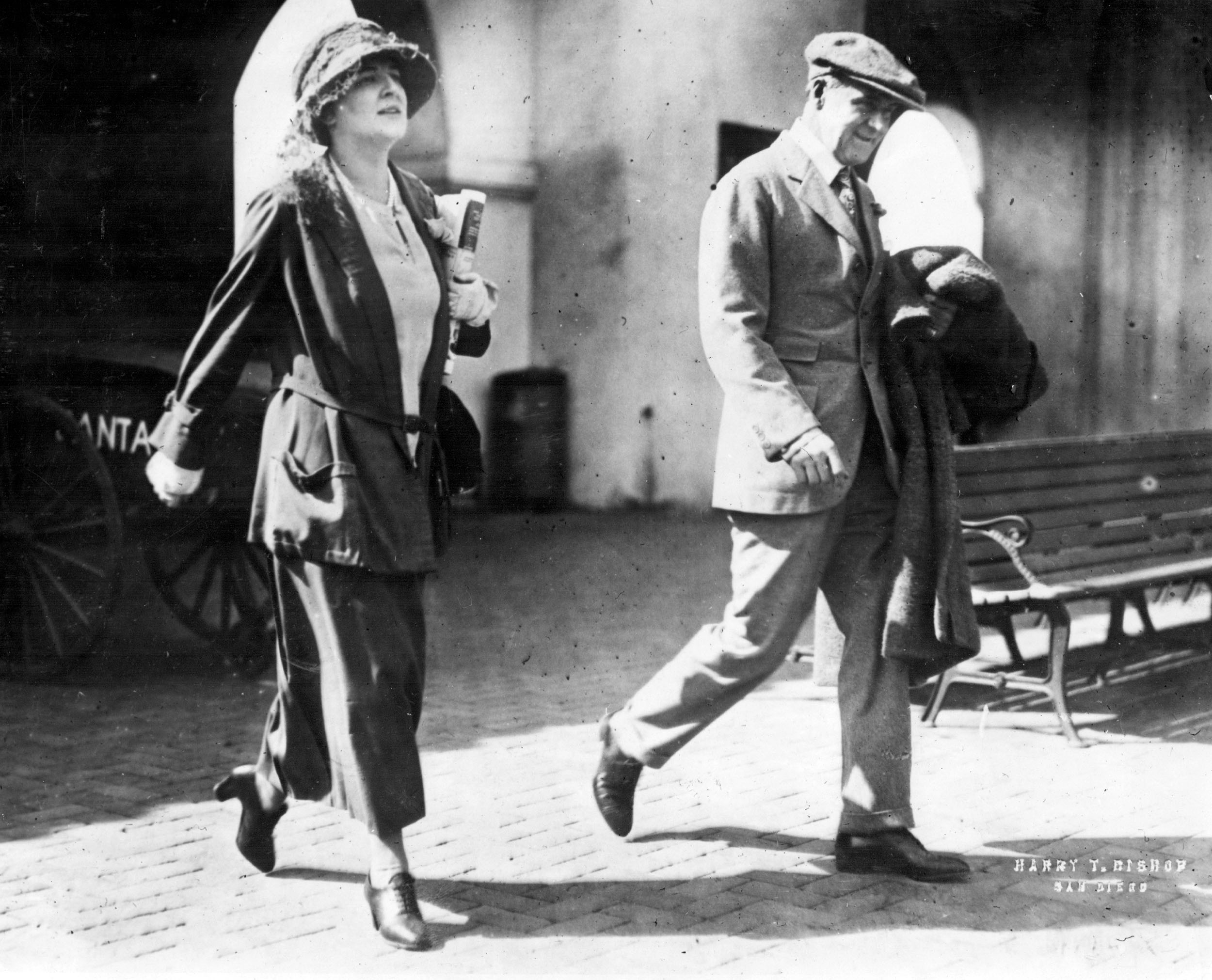
fall easy prey to San Diego’s Harry Bishop. March 10, 1923.
He got to the patio, picked out a spot, planted himself and set the range for fifteen feet. He was in the shade of the trees and he wasn’t sure he had the correct exposure. Too late to change — he didn’t want to be fiddling with settings when it was time to be taking the picture. His wait was short. Ganna and McCormick came out of the station well in advance of the reporters who unaccountably were trailing behind, and Harry, surprised but pleased at the lack of clutter, could only surmise they’d run out of questions or had become convinced it was hopeless. He waited until they were almost upon him, then began walking backward, keeping the distance, waiting for Ganna to get out of the shade, and finally, when he feared he might stumble and fall — an embarrassment he’d never live down — he triggered the camera and hoped for the best. By the time he replaced the slide and reversed the film holder they were too far away for a second try. Indeed, they had entered a car and were being driven away. He would sink or swim with what he had in the camera.
Only later in the dark room when he saw the sharp, clear negative and the print it made did he realize how lucky he’d been. Ganna had lifted her veil, probably while walking through the station, and he hadn’t noticed. Not for his benefit, he was certain. Maybe she thought he’d given up. One thing. He was glad they hadn’t stopped to pose. A setup picture would not have come close to the one he gave the city desk.
The print showed her with head held high, classic features lighted by soft rays of the sun filtered by leaves of the trees. McCormick, twenty years older than Ganna, caught in the brutal sunlight, didn’t look his best.
“Good picture,” said a city editor. “Haughty diva and aging tycoon.”
Just what they want in the East, thought Harry; his chance for a bonus looked good. At the same time he felt compassion for Ganna and McCormick who though sorely tried had maintained their composure throughout the ordeal. He saw Ganna, not as a haughty diva, but a classic opera star, poised and dignified — and in very good condition. McCormick, he saw as an old fashioned gentleman; getting on a bit but game as they come. He wished them well.
The story as it appeared in the paper showed remarkable compassion, heavy editing, or a lack of homework in failing to mention Ganna’s war with the critics, McCormick’s operation, his feud with the opera company, the divorces and the six-minute marriage in Paris. Instead it concentrated on Ganna’s dress and “chic little veil” and her coyness in slipping Harry’s photo punches. Harry overheard but took no part in a newsroom debate about a segment in the story that described Ganna’s smile as “the kind that makes a conquest…whether the owner can sing…or not.” Some reporters thought it was a bit of a thrust at Ganna for her well known compulsion to choke. Others thought it was just more fluff in a story geared for the socialites in town. As for Harry, his only responsibility after the paper came off the press was to make sure his photos were right side up and the captions made sense, and he kept his thoughts to himself. He wasn’t paid for his opinions on editorial content and he never offered any, but he suspected that the papers in the East, using the picture as an excuse for a story, would furnish readers a bit more about the trip to San Diego than what Ganna wore when she stepped off the train.
He knew the Los Angeles office of P & A Photo Service would want copy prints as soon as possible, so he put up a package and sent it to the train station for an early evening run. Then, skipping dinner, he started the process work for tomorrow’s papers, feeling good about the way things had worked out. Very good indeed. Maybe a little hungry.
He checked in early next day to hear a roar of approval from the managers of P & A. They called to say “thanks, Harry, great job; stayed up all night making prints to distribute across the country. Look for telegrams, Harry, we’re putting it in writing.”
Two telegrams arrived for Harry on successive days, both from the assistant manager at P & A. The first one said:
Dear Bish:
Mr. Mathieu, president of P & A wires me from New York as follows: `Congratulations McCormick Walska. Write me details how accomplished.’
Drop me a line when you get a chance and let me know how you hid out on them long enough to get a picture, will you? I’m curious to know how it was done. You can be sure I’ll write him and I will see you get plenty of credit. And now I’m going home to BED. I have been at it nearly 48 hours on this thing. Russ and I worked all night getting out prints. And the old eyes refuse to stay open any longer.
Yours,
Frank B. Howe.
Harry was impressed. Forty eight hours? They must have made copy prints for every paper in the country. Big job, making that many prints, mailing them out. You’d think there would be a better system in this day and age. (The “better system” — transmission by wire photo — arrived in 1935. Until then photo services had to mail the pictures individually to each of the newspapers they served.)
The message from Howe was nice, but it would have been nicer had a bonus been included. Harry could only tell himself maybe the people in New York would come through. They certainly were making a fuss over the picture.
The people in New York came through. The message the following day, also from Howe, said:
Dear Bish:
I can’t begin to express my admiration of your wonderful work on the Ganna Walska and Harold McCormick picture.
I don’t know whether you knew it or not but the best photographers of New York and Chicago have been working their heads off for six months to get a picture of the two of them together, and have failed miserably. As far as I know you are the first man who has succeeded; and the picture itself was certainly a knockout. Russ and I worked all night getting the thing copied and printed, and this little note of appreciation may sound somewhat sleepy as the result but I do at least want to say that your work certainly strikes me as worthy of the best tradition of this peculiar game. It may interest you to know the Times “made over” two hours after deadline to get it in.
Enclosed herewith is a check for ten bucks as a bonus for the print you sent up, also a receipt which I will be grateful if you will sign and return to me so that I can get my ten bucks back from New York. Thanks a million times.
Sincerely,
Frank B. Howe.
That afternoon, Harry took time off to go to the bank and cash the check, and although he knew he’d be up all night processing film and making prints his spirits soared. Here it was the end of the week and he had a ten dollar bill in his pocket. And eighty seven cents.
* * *
Harry was right about Ganna’s physical condition. She lived to be ninety-six years old. Spent the last 40 years of her life on her 37-acre estate in Montecito, California. Died in 1984. Left behind a collection of tropical and subtropical plants in a highly regarded garden called Lotusland which was opened to the public in the early 90s. McCormick died in Beverly Hills in 1941. He was praised for his support of cultural and educational organizations and for establishing a clinic to study infectious diseases. Research at the clinic led to development of a treatment for scarlet fever.