Accolades and adequate pay were Harry’s reward for years of honest labor. Sleeping well was his bonus; no bothersome dreams or nightmares for Harry. Sweet is the sleep of the laboring man. It was in Harry’s case.
Until the night of May 11, 1932.
While on assignment that morning he witnessed a tragic event the horror of which he would not forget: two young Navy men plunging to death from the Akron; one flopping about as he fell, strangely relaxed or unconscious — or perhaps accepting his fate; the other, clawing the air and pumping his feet in gallant but hopeless desperation.
Through the rest of his time in the darkroom, in the evening hours at home, Harry was unable to shake the vision — a demon of death in pursuit of the boys — for the vision was locked in his mind. It murdered his sleep that night — and many nights to come.
* * *
It was said to be the biggest and fastest airship the world had ever seen. An aerial aircraft carrier. Commissioned to scout the oceans along with the surface fleet. Could carry a squad of planes in a hangar within its hull. Could launch and recover the planes while maintaining itself in flight, an innovation never before employed.
Along with its sister ship, the Macon, it represented an undertaking its designers and builders believed had at last achieved the ultimate rigid airship.
It was doomed. It would live for eighteen months then be lost in a storm at sea along with most of its crew.
It was shortly before the end, on a mesa in San Diego, that the two young Navy men gave their lives helping the mighty airship battle a gust of wind.
Its skipper had monitored weather reports while dodging winds and rain storms in a four-day flight from its base in Lakehurst, New Jersey. A radio message sent to Navy headquarters in San Diego seemed to reflect his awareness of the airship’s vulnerability. It said the Akron would arrive late in the morning or early in the afternoon “if there is no mishap.”
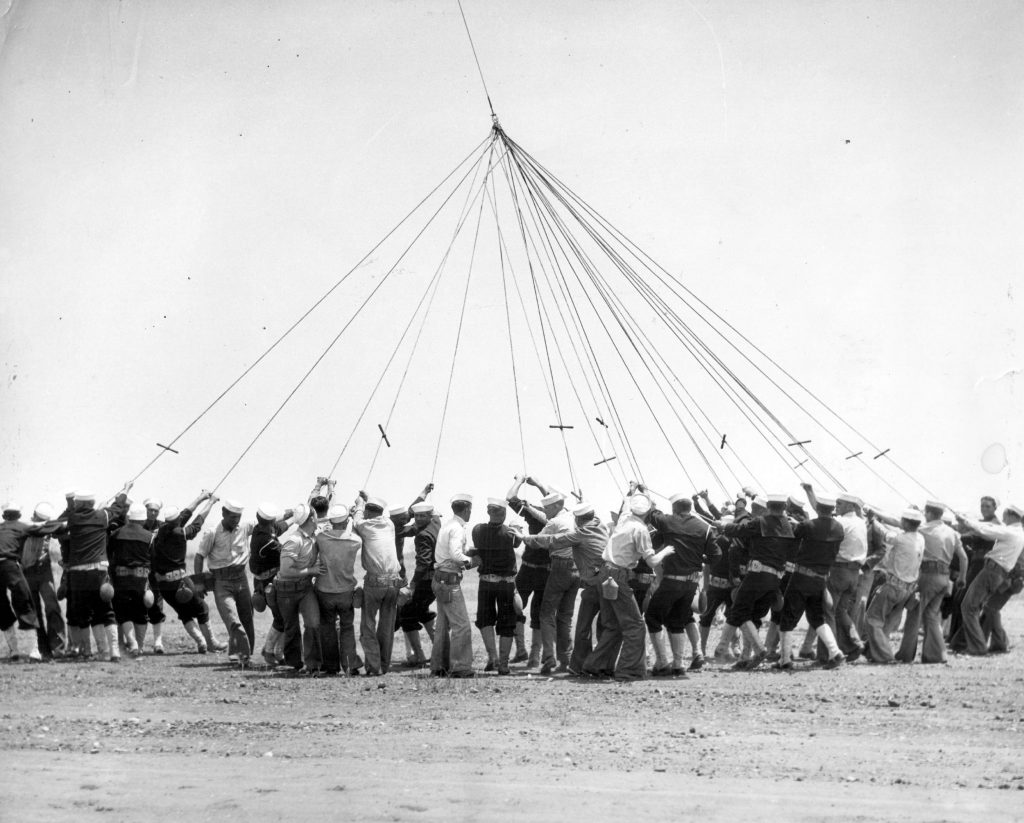
It had hovered off the coast for several hours waiting for the weather to clear before attempting to tie up to a seventy-foot mooring tower especially rigged on Camp Kearney1Now the location of the Miramar Air Station, 11 miles north of the city. Civic leaders hoped that a successful mooring would give the city a leg up in competition for a west coast base for the airship fleet the Navy was said to be planning. They had called for a whistle-blowing, horn-honking civic welcome at the first sight of the Akron.
Though it wasn’t certain the Akron would stop in San Diego or proceed further up the coast to Sunnyvale, California, where a base was under construction, two thousand people or so were at the mooring site hoping to see the airship. And if some were expecting excitement beyond a normal mooring you certainly could not have blamed them. The rigid frame airship had had a spotty record for safety and reliability. Germany had put more than a hundred into the air on bombing raids and scouting missions during the 1914-1918 war in Europe and only a handful had survived. Though the concept had flopped in war there was hope it might succeed in peace. Advocates could point to Germany’s original Graf Zeppelin as proof that a well designed dirigible handled by competent officers could fly passengers safely, and indeed the huge airship was to continue in use in commercial flights without mishap until 1937 when it would be retired following the Hindenburg disaster. But the Graf Zeppelin was an exception. Other rigids were being destroyed in accidents, one after another. The challenge was to make them light enough to be lifted into the sky, yet strong enough to survive in a hostile weather environment. American leaders hoped the rigid frame airship could be perfected and serve in defending the nation from possible enemy attack.
The Akron was 785 feet long, had an aluminum alloy frame stout enough to hold an aircraft hangar inside the hull for five airplanes to be used for scouting missions. The planes could be lowered from the hangar by crane and launched while the airship was in flight. They could fly their missions, return, hook on and be taken back into the hangar. The airship’s eight powerful German-made engines had propeller shaft extensions that could swivel to provide thrust upward, downward, forward, and back. Top speed was 84 miles an hour. Control and engine rooms were designed for a crew of 77 enlisted men, 12 officers, and half a dozen pilots, all who had sleeping berths, work space, and access to a kitchen in operation round the clock. Twelve fabric compartments inside the hull were filled with non-inflammable helium gas. Construction had been supervised by experts using the latest technology. It was the biggest, most advanced of its kind in the world. The Navy thought it was needed. The only airplanes available to that branch of service lacked the range desired for ocean surveillance in a world that had suddenly grown smaller. Maybe the airship would be the answer.
The Navy had lost the Shenandoah but had had success with the Los Angeles, an airship it had commissioned the Germans to build in the 1920s. It went ahead with plans for two large rigids to be built in America using German technology, the Akron and the Macon.
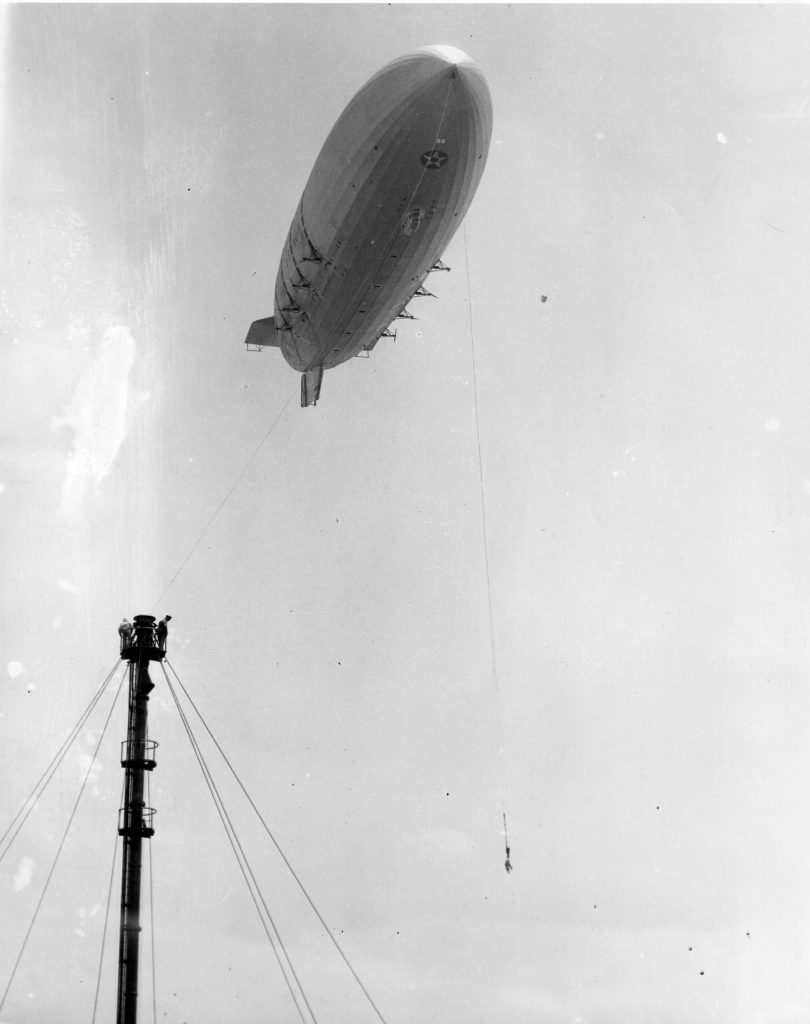
Among the laymen doubters awaiting the Akron’s appearance were a couple of locals, Harry T. Bishop and Tom Warne, newsmen assigned to cover the arrival, Harry with a camera, Warne with a notebook and pen. They wished the Navy well but they shared the opinion that there was little use for the dirigible in modern warfare. Harry couldn’t help but think that a good gust of wind might send the thing back to Lakehurst, but didn’t say so. He figured there was an outside chance that the Navy knew what it was doing. There was nothing to indicate otherwise as the Akron approached the tower. The temperature was 64 degrees, the low ground fog had all but dissipated and conditions looked good to observers. Two hundred or so Navy enlisted men, who were to guide the ship to the tower once mooring lines were dropped, milled about below, some quiet, some animated and some messing about as servicemen do, but all on the alert for the lines to drop.
Just before 11 a.m. the Akron began its approach; dipped slowly over the landing site but not low enough to drop the lines and had to circle the field and make another try. In the wait for the slow moving giant to try it again, Harry and Warne shared a thought: though the air on the mesa was calm, the air up above might be tricky; that could be causing the trouble. When two more attempts also failed the newsmen looked at each other and nodded knowingly — the Navy has a problem. The fourth attempt succeeded. The lines were dropped and grabbed by the men on the ground, and when the airship’s nose cable was secured to the mooring line on the tower, onlookers breathed a bit easier. Now all the crew had to do was to walk the ship to its berth.
Harry prepared to take pictures. He’d held off because his old auto-Graphlex required a manual change of film after every shot and he wanted to be ready if something unusual happened. It looked as if nothing would so he decided he might as well pop off a shot or two.
Warne had jotted down a few notes on the reaction of the crowd to the unexpected number of mooring attempts and was recording the time, 11:40 a.m., when a sudden gust of wind hit the sensitive monster and caused it to roll and lurch and snatch the lines from the men on the starboard side of the ship. The port side crew held on and the men were dragged across the mesa until the ship began to rise and — it was later reported — an officer shouted “let go!” Most of the men responded; ten were yanked into the air; seconds later seven released their holds and tumbled to the ground. The last of the seven, E.G. Walkup, 20, of San Diego, dropped 15 feet and broke an arm. Three men were left dangling as the airship continued to rise. Nigel M. Henton, 19, of Fresno, California; R. H. Edsall, 24, of South Bend, Indiana, and C.M. Cowart, 19, of Sand Springs, Oklahoma, intent on helping control the Akron, failed to react quickly enough. Cowart survived to explain why he failed to let go of the line while he still had time: he wanted to drop when he was 25 feet off the ground but was afraid he’d land on someone; he decided to gamble and hold on. The thoughts of the other two, Henton and Edsall, were carried with them to their graves.
The gasps of shock and dismay that had erupted from the crowd when the airship had lurched upward gave way to silence as Walkup fell to the ground and the danger to the three men became apparent.
Harry, startled by the action, recovered quickly and aimed at Walkup as he fell, but as he triggered the shutter someone jumped in front of his camera and spoiled the shot. He inserted new film and stood ready for whatever would follow. He noticed that the three newsreel cameramen who had begun to crank their machines when the mooring attempt started continued to grind away as Henton, Edsall and Cowart were pulled higher and higher.
Harry took a picture when the men were about 200 feet in the air and then reloaded quickly, wondering what would happen next.
He feared someone would fall. How long could they hang on? The Akron’s nose cable was still tied to a line secured to the mooring tower and if the airship could lower itself and allow the those below to grab the lines once again maybe the boys could be saved.
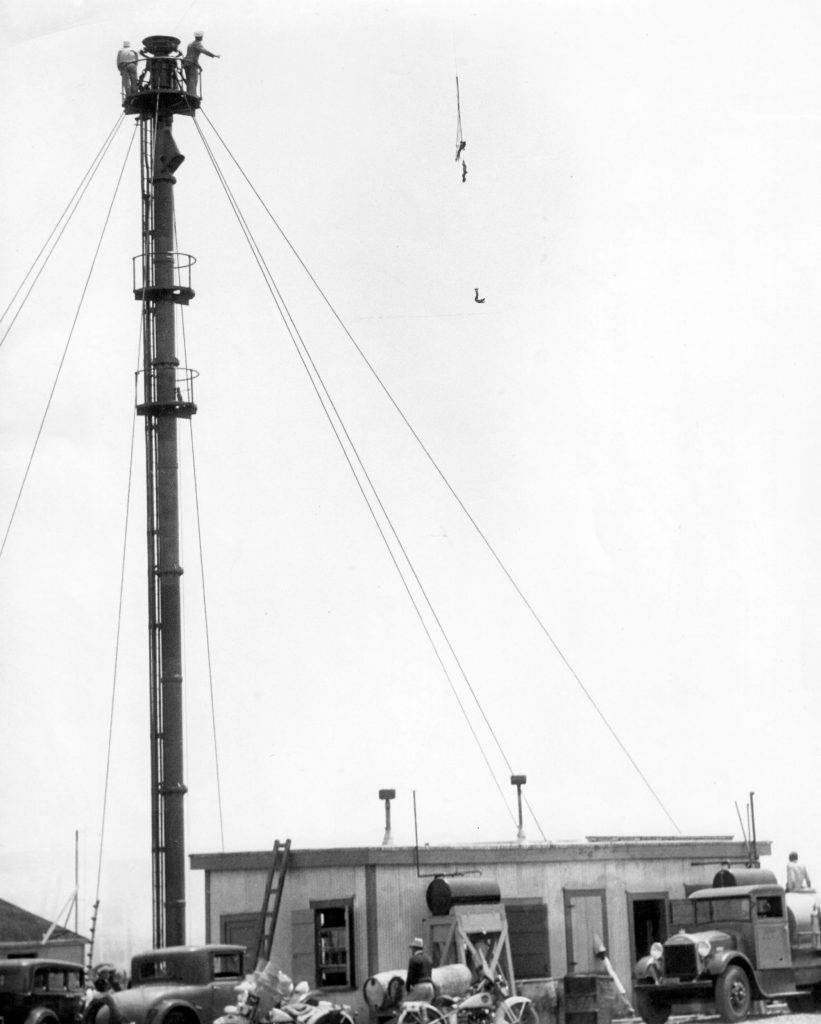
Henton was the first to give out. It couldn’t be seen and no one could know but he must have realized he was losing his grip in the unfair fight for survival. He dropped, dreadfully relaxed, his body flopping slowly back and forth until it hit the hard packed mesa.
Harry triggered his camera an instant after Henton started to fall and he knew he’d got it on film. He was behind a maintenance shed and he couldn’t see Henton hit the ground, but in the silence that followed the initial cries and groans of the crowd as Henton lost his grip he heard the awful sound. Harry swapped film as fast as he could but too late to get a picture of Edsall who followed Henton’s plunge. Unlike Henton who’d seemed to have lost consciousness, Edsall kicked his feet and clawed the air during the fall.
The Akron was still attached by cable to the tower and the stern of the ship was rising. Officers on the ground realized the ship might soon be standing on end — it had happened to the Los Angeles — or the line might be ripped from the nose of the ship. An officer ordered the cable cut and when it was done the Akron leveled off and floated free — with Cowart hanging on to the line.
Shocked by the sight of his crew mates falling, Cowart held on as tight as he could as the ship rose slowly until it reached 2,500 feet. He was dangling 300 feet below the craft, aware he was slipping downward inch by inch, and that sooner or later he would be unable to sustain his body weight with finger grip alone. A well conditioned athlete, he told himself he wouldn’t give in — while sliding downward slowly. Then he had a bit of luck, luck that had been denied Edsall and Henton. His feet came in contact with a metal toggle pin inserted crossway in the line as a handhold. It was rounded in the center and the pin itself was three inches across; barely enough extension on both sides for each foot. If he could keep his balance he might be able to draw up that part of the line that hung below the toggle pin and wrap it around his waist. Hold on tight with one hand and put his weight on the toggle assembly. He would be at the mercy of the wind; one good gust would do it; he would lose his balance, his feet would slip and follow his mates to the ground. But he had to make the try; his fingers were giving out.
He made sure his feet were planted firmly on the toggle pin before he took one hand off the line while maintaining a grip with the other. Carefully, he pulled the line beneath the toggle pin up to his waist and wrapped it around his body. Then he tied a bowline knot and once again was able to hold on with two hands. But there might be another problem, he thought. His feet bore most of the weight and his hands were taking less punishment, but it would take some time to pull him aboard and he might pass out in the meantime. If he did, the line around his waist would support him but it also might stop the flow of blood or paralyze a nerve. He’d have to stay conscious; count on the Navy to save him.
The Akron’s skipper had ordered his crew to assemble a winch. They rummaged for parts and put one together starting from scratch. Below, the crowd had swelled to thousands; city police and the highway patrol had been summoned to manage the throng. Cowart had been clinging to the line for eighty minutes when he felt the first tug that told him he was being drawn up toward the airship. It was 1 p.m. and the crowd noise picked up as the word was passed that the rescue was taking place.
He was pulled into the Akron at 1:15 p.m., happy to be aboard and pleasantly surprised by the aroma of a well stocked kitchen. While crewmen were pummeling his back and officers were thanking their stars, the smell from the kitchen took his mind off his escape, and after the doctor pronounced him fit he asked for a sandwich and hot cup of coffee, which he consumed in a matter of minutes.
The ship continued to circle the mesa, waiting for kinder winds expected later that day.
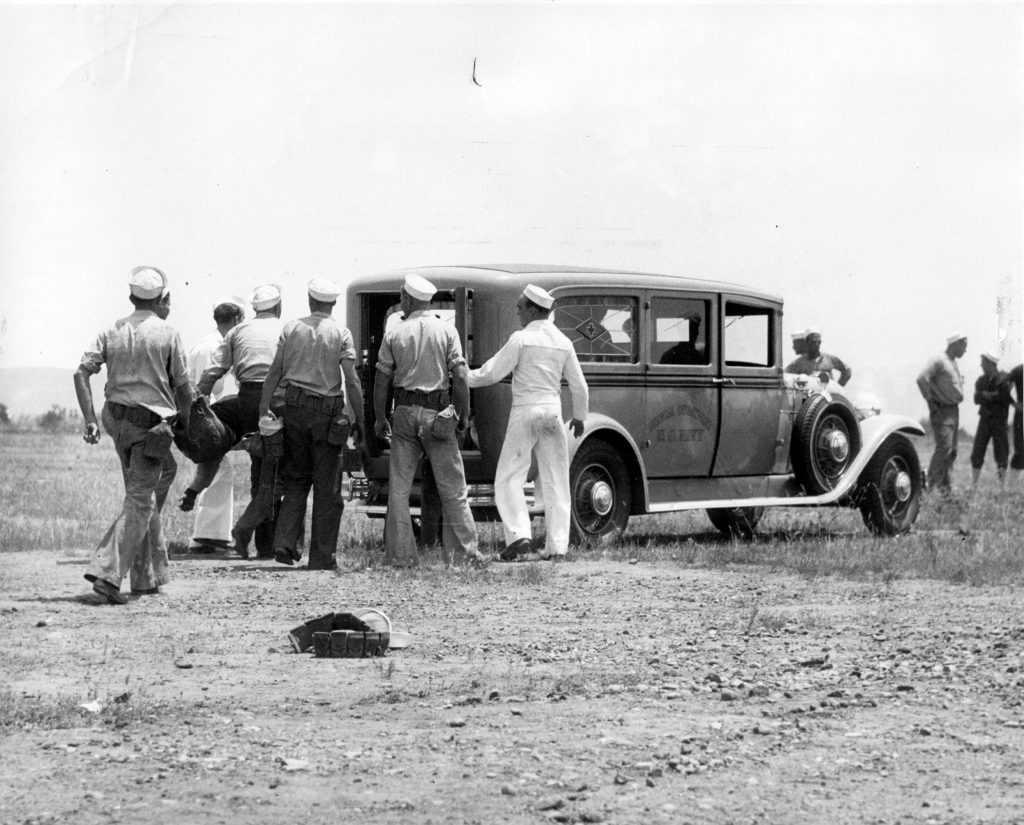
Harry was ready to leave for the newspaper plant. He’d taken pictures of Navy corpsmen placing the bodies of the two men in ambulances, and had considered but rejected shots of badly shaken people being treated by doctors and nurses. He sought out Warne and they returned to the parking lot and climbed into their car, Harry anxious to deliver his pictures and Warne, a wire service reporter, was eager to file his story. They’d been told the Akron would make another attempt to tie up to the tower later that afternoon and they wanted to get back to the mesa to witness the second attempt.
Only while processing other pictures could he free himself of the image — and then for only a while. Back it came, again and again.
After he’d delivered his pictures he thought of Warne and the conversation they’d had on the way back to the office. Warne had talked about the people he’d seen being treated by the Navy corpsmen — the shock in their eyes. He’d talked to some of the other still cameramen there to take pictures and every one of them said they’d been too caught up in the drama to get any shots at all. The motion picture people said they’d been cranking their cameras from the start and had continued mechanically, almost unknowingly, their eyes riveted on the action. (The sequence is shown on television stations occasionally and to some it’s more frightening in its realism than most of the shockers contrived by television and movie people.)
The afternoon paper, the Evening Tribune, used the picture of the falling sailor and one other picture in the final edition that day and in earlier editions the following day. The morning paper, The Union, presented a complete report with sidebar stories and several pictures, but chose not to publish the death plunge picture. When an editor told Harry the reason he hadn’t used it was he was afraid it would upset expectant mothers, Harry assumed he was kidding.
But he wasn’t entirely sure.
Thirty years later, he still wasn’t sure.
* * *
Wire services chose the picture as the best news photo in 1932. Fourteen years later, the National News Photographers’ Association included it in its selection of 100 top news photos of the half century. The picture finally made The Union, along with a story of the award.
The Akron was destroyed in a storm off New Jersey in 1933. Seventy three of the crew of seventy six died. No life saving equipment had been carried. Its sister ship, the Macon, was hit by a gust of wind off Point Sur, California, February 12, 1935, and fell in the ocean. Two crewmen died, 83 were saved. Life equipment had been provided after the Akron disaster.