It was a nice little waterfront air strip there at the foot of Broadway. Handy for Harry, who was beginning to market his photos and could afford to hire a plane. The runway was short and there were smoke stacks to dodge when coming in for a landing, but the hard packed alluvial soil made it seem smooth as a board compared to the others in town.
The war that had ended two years before had left a surplus of pilots and planes and the city because of its climate had more than its share of both. Some airmen, discharged when the nation disarmed, bought war surplus planes for commercial endeavor and now were scratching for business. Buy an old Jennie for two hundred down and take your show on the road, sell rides to the public at ten bucks a pop, exhibit your daring at air shows, pay off the loan and start raking it in. That was the way to go for many a hard-up airman. In a very short time, war surplus pilots in war surplus planes were hopping from city to city demonstrating their skills and performing their hazardous stunts. Barnstorming had come into its own.
Less flamboyant but equally intense were aircraft designers who took proven designs developed and tested by Wilbur and Orville Wright and added ideas of their own. Exploiters or true innovators, some of their refinements and add-ons helped push aviation along.
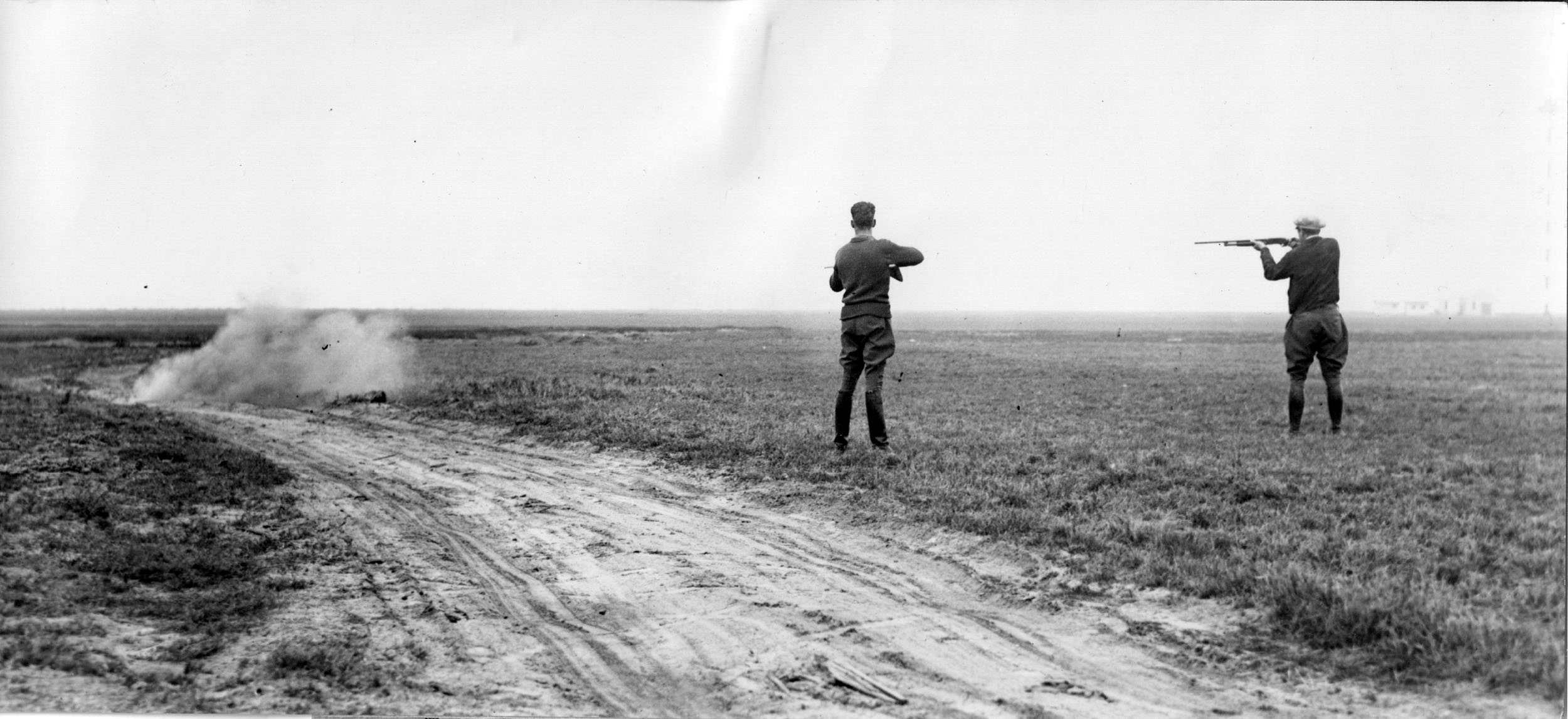
While the designers and dreamers were apt to stay put, the barnstormers spread through the nation. Pop in for a show, exhibit your skills, then on to the next likely town. Work your way west and maybe catch on in the movies. What attracted them to the waterfront strip — aside from the perfect location — was that hard packed alluvial soil that made landings and takeoffs a pleasure. No rabbit holes on the runway; no bothersome, burrowing rodents like those on the strip at North Island where Air Service pilots were frequently seen patrolling the strip with shotguns or blasting away at the creatures.
Harry knew the airfield’s days were numbered. Harbor Department officials were planning a more profitable use of the land. Knowing he would soon have to travel to other landing strips to engage a pilot and plane, he bought a second hand Model T Ford, mastered the use of the hand crank (after a week with his arm in a sling), and was ready to cover the county should officials go through with their plans.
Today he drove slowly down Broadway, past the Santa Fe station, across the tracks and the highway and onto the waterfront strip. He parked the car, switched off the engine, applied the hand brake and looked around for the pilot. The Standard was there, a two seater biplane, one of the costliest war surplus planes. It was parked in front of a maintenance shack that also served as a pad for hard-up barnstorming airmen. A ground mechanic was lurking about but the pilot was nowhere in sight. Harry suspected he was inside the shack tinkering with something or other; the man knew how to keep busy. No matter; the appointed time was 10 a.m. and it was barely 9:45. The sun was out but the air was still cool and as he settled back in the seat his thoughts drifted back as they frequently did to the day his life turned around. The day he met Grace…

He is with the band in the orchestra pit, the house is packed for the vaudeville show and shrieks of delight and wild applause greet every act on the bill. Singers and dancers, jugglers and clowns, cross-talk comics, high wire walkers and trapeze flyers all win boisterous ovations. But the attractive blonde, second row center, next to the boy about 12, though mildly amused retains her composure and doesn’t respond to the pratfalls. It is Harry’s belief the reason she’s here, she’s giving the kid a treat.
He begins showing off with the sticks; flipping them high in the air and never missing a beat. Nothing overly flashy — but he sure wants to catch her eye; the lady’s a stunner.
Intermission. The boy approaches and asks to examine the drums. The woman watches with calm, grey eyes that show a trace of amusement. After a while he takes the lad by the hand and guides him back to his seat and as he had planned, he is introduced to the lady who would later become his wife.
Off to San Francisco; more opportunity there to make it as a musician. The letter from the draft board. The year in the army. The broken foot on the obstacle course. The medical discharge. Starting again in the gin mills. A couple of fruitless years. Then realization sets in. It isn’t the life for this family of three. Grace had known from the start; it took him three years to make sure.
Back to San Diego. Living on Grace’s investments while he works as an apprentice in a photo shop. And now a freelance professional making it on his own.
The rudder flaps and the elevators wave and Harry comes out of his dream. The pilot had been there all along; hunkered down in the cockpit fiddling with the controls; he can see his rounded back. Should have known, of course he’d be there, checking things out, making sure his craft was in order. The man was a thorough mechanic, best of any he knew, and by far the finest pilot.
He raised his head, saw Harry; boosted himself from the cockpit; leaped gracefully to the ground; waved and approached while wiping his hands on a clean, red cloth, a friendly smile on his face. Lean and lanky, a seat-of-the-pants flyer, jodhpurs and leather boots — a Rockwell painting, circa 1920. Harry’s favorite pilot, the one he hired when he wanted aerial pictures.
“The man’s a wonderful flyer,” he said to Grace. “He’ll stand his plane on a wing to get the shot I want.”
Courteous but not pretentious, an air of refinement about him not found in the other flyers who had purchased war surplus planes and gone into the barnstorming business. Articulate yet unaffected. Sounded more like a college professor than a barnstorming pilot for hire. Listened without interrupting and when he responded got right to the point. Youthful, slim and neat. Knocking the ashes out of his pipe on the heel of his boot, it was hard to picture him tinkering with carburetors, fuel lines, pistons and valves. The thing about his friend, James Stewart, was though daring as any who flew, he knew his plane’s limitations. Knew his craft was a flimsy contraption, a wooden frame held together by piano wire, cloth and hardened glue — and he knew how much it would take before it burst apart.
On this day the assignment is to get pictures to promote Greenwood Memorial Park, a 100-acre cemetery east of the city.
The pilot, with offhand grace, leaps up and over the side of the plane, slips into the front cockpit and begins to check the controls. Harry wedges his bulk in the seat behind and when the ordeal ends and the plane stops shaking, the ground mechanic steps up and swings the propeller a couple of times to turn the engine over. He pauses and looks at the pilot who signals “contact!” The mechanic repeats the word, then runs his hands along the gentle curve of the wooden prop to get the feel. Then he lifts his leg in the air and gives a mighty pull. A sputter, a strangled cough, a roar. The pilot throttles back and the engine retreats, becomes a steady hum. The mechanic removes the wooden wheel chocks, steps away from the plane, raises his hand to the pilot who nods and kicks it up a notch. The propeller becomes invisible and the plane moves slowly toward the head of the takeoff strip, gets into position, hesitates, roars a warning, rolls down the runway, picks up speed, and angles up into the sky.
It’s a beautiful, sun-shiny day. No sign of haze or fog. A few small clouds adrift in the blue. The pilot circles his biplane over the cemetery until Harry has all the pictures he needs. It’s barely within the time limit for the fee agreed upon but when he signals his friend to head for home the pilot turns and grins and banks the plane in the opposite direction. A long, lazy tour of the area follows. A special treat for Harry, a special treat for a friend. His plane rides have always been on assignment and no time wasted for sightseeing. Get to the target and shoot. Hightail it back to the airfield. Motor back to the shop, soup the film, make the prints and look for another client. That was Harry’s style. He had frittered away too much of his life — as a reporter in San Diego until his name was scratched from the roster, and as a musician in San Francisco until Grace had opened his eyes — and now at the advanced, old age of twenty six, married with an adopted son, he’s a man in a hurry; bound to win in his third attempt at a lifetime career. He had worked hard in the three months since his return, learning photography and darkroom technique, turning pro and opening a shop, taking the pictures and making the prints and keeping the books up to date. He could use a break in the daily routine. And so he settles back as his pilot friend banks the craft, circles the city and harbor, and dips low to buzz the new Marine Post near Dutch Flats on the bay. Amusing to see playful recruits on the parade ground aim their empty rifles while angry drill instructors glower and shake their fists.
While banking slowly over the bay the pilot looks back and motions to Harry to continue taking pictures and for a moment Harry is tempted. The market for aerials is expanding and his friend is saying go ahead, my friend, it’s on the house. But Harry decides against it. He’s on a sightseeing tour and enjoying it too much to be working. Only when the needle on the gas gauge edges to zero does the pilot bank his plane in a downward glide to the airfield and side-slip in for a landing. Once on the ground he brushes aside Harry’s offer to pay for the extra gas and with a pleasant smile says “Glad you enjoyed it, old friend.”

Harry shakes his hand and goes back to his shop, vowing to repay the kindness some day if he can. Three weeks later Harry has the job he had always wanted: chief photographer for the two main papers in town. He had worked late, developing film and making prints as he had every night since he’d been hired by the Union-Tribune Publishing Company. Overdoing it, he knew, but this was the job he’d been aiming for, the career he had most desired, and this time he had to succeed. For Grace. After what she had gone through….
She had agreed (in 1918) to marry him and live in San Francisco where he would become a successful musician. He was drafted into the Army on the day he arrived. He couldn’t support Grace and her son but she moved into a small apartment and took care of herself and the boy. When he was medically discharged after breaking a foot, he caught on with a cabaret band — and Grace endured three long years giving moral support to a career she didn’t believe in. The humorous little stories recounted by Harry each night — usually concerning middle-aged men failing to act their age — soon became sordid and then repetitious as Prohibition went into effect. Bootleg whiskey made the patrons rowdy and the brawls more frequent and vicious. The decision to return to San Diego followed a cabaret shooting that nicked a patron, took sheet music off a trumpeter’s stand and whistled past Harry’s head.
He took a job in a camera shop for five dollars a week. Grace’s investment earnings paid the rent for Harry, Grace, and Grace’s son, Robert Ryan. It was another blow to his ego, but the only way he could master the craft and the intricacies of the darkroom. In three months he was his own boss and in a year, a successful freelance photographer attracting the attention of the managers at the Union-Tribune Publishing Company who offered him the job as chief photographer. He started work there November 28, 1921, his second attempt at a newspaper career but this time in a job he could handle. He knew there would be policy work but he was unprepared for the volume. Pictures required by the two newspapers for advertising and publicity took most of his time and after two weeks he was wondering if he would ever go out on a story.
A leathery little agent of the United State Customs Service had been working on a case that was to provide just that. Weldon C. Evans was known for his zeal in rounding up opium smugglers along the Mexican border, and for the numerous arrests he made of “illegals” crossing the border. Though his many accomplishments did little or nothing to stop the traffic in either case he continued to battle the tide. His burden was further increased with the coming of Prohibition and the order to prevent the smuggling of booze from Mexico. Valiant as he was in pursuit of the rum runners who sneaked across the border, his endeavors went unnoticed until he captured a gang in a boat off the Coronado Islands and confiscated cases of whiskey said to be valued at $20,000. Then with the help of a generous press he became a hero to right thinking people in town.
Harry had met with Evans occasionally for coffee and the two had cemented the kind of relationship that a newsman and his source hope will benefit both. He had stressed the importance of calling him on breaking news and Evans had assured him he would. He’d worked late as usual on that particular day and he’d chatted with Grace for a time before turning in. It seemed as if his head had just touched the pillow when the telephone rang. It was his friend the customs agent and he told Harry to be ready in 15 minutes — they were going for a ride in the country.
Evans at the wheel of his touring car, his full weight on the gas pedal, bleary eyed, in need of a shave but keyed up nevertheless, was in a strong-silent mode and declined to answer questions. They rode in silence and a semblance of comfort until they ran out of pavement and onto a mesa north of the city where they rumbled along making tracks of their own on redding soil and hard pan clay and then weaving their way through dust covered sage brush, evergreen chaparral, and occasional clumps of tree-like shrubs. Evans continued to abuse the gas pedal and Harry’s desire for information was curbed by his wish to remain aboard the open-air car. He was holding his equipment with one hand and had a grip on the door with the other. He had already lost his hat and was reminding himself to look for it on the way back.
They came to a grove of trees — some cypress, some eucalyptus — and Evans stopped the car. He switched the ignition to off and Harry was amused to see the motor rattle on until cursed and kicked into submission. Evans led the way to a large clearing not much more than 100 yards long and half as wide and all but ringed with trees. At the near end of the clearing were several structures, remnants of a deserted ranch or farm, and beyond them an object Harry, still uninformed, was surprised to see.
He looked at Evans. “My gosh,” he said. “Smugglers?”
“Right.”
“Using the plane?”
“Yes.”
If true, it might be a first, this use of a plane for smuggling booze. A plum for Evans for sure — and a heck of scoop for Harry.
“The pilot?”
“In custody — with two others.”
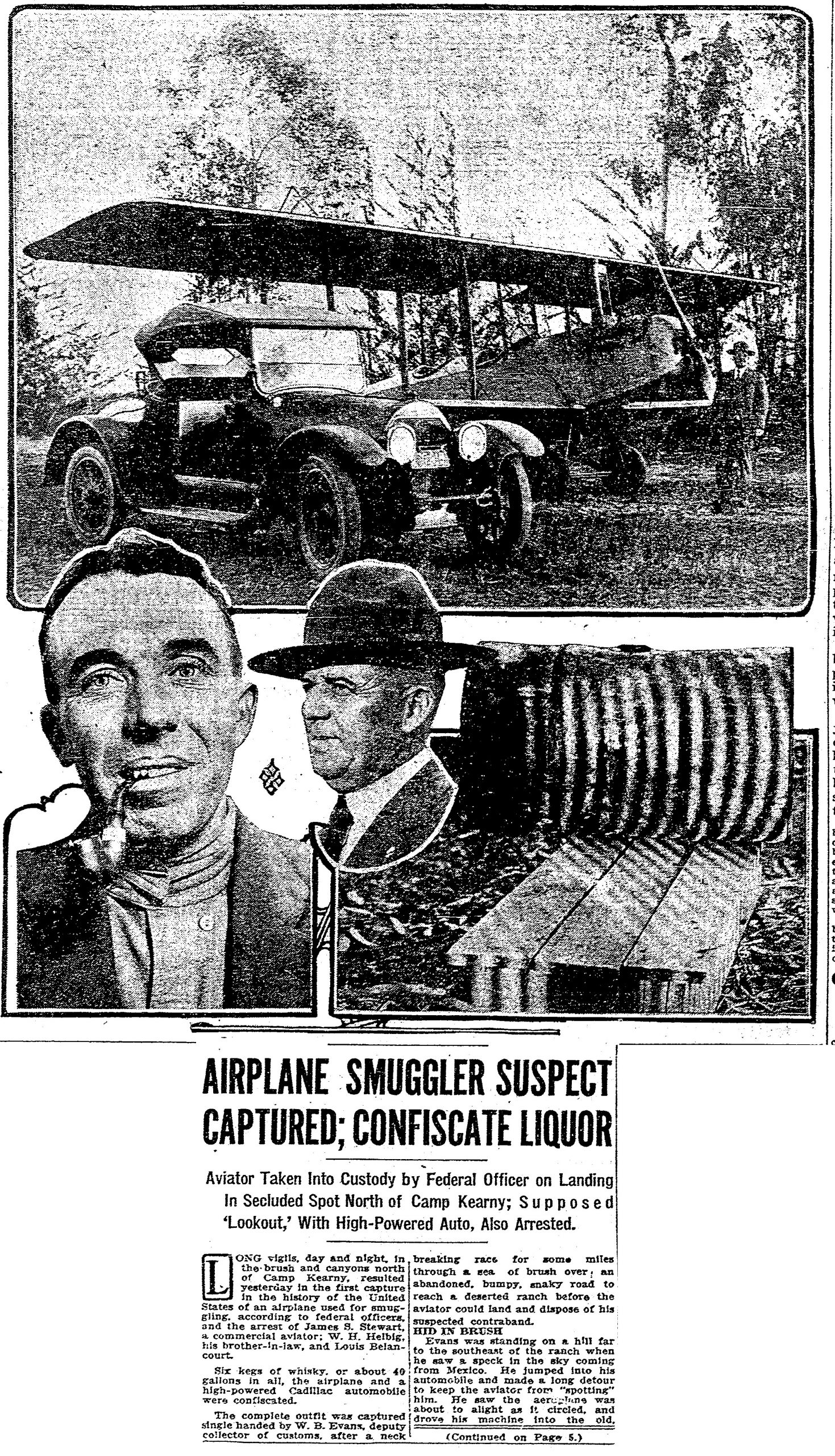
Harry examined the aircraft, a single engine biplane with two open cockpits, common in the area; surely a war surplus plane. No discernible markings on body or wings, only splotches of oil or grease that might have covered the markings. Crudely done, thought Harry. And mighty suspicious too. The pilot must be dumb, though a heck of a flyer, landing the plane on this strip.
He looked again at the opening between the trees where the landing took place. He could picture the flyer coming in slowly, throttling down, just enough revs to keep his engine from stalling. He’d be swinging the tail from side to side, scanning the clearing from right to left, looking for rocks and holes. Once he touched down he’d have to coast to a stop. He was sure the plane had no brakes.
“It would take a magician to fly that plane in and out of this place,” he said.
“The man is an excellent flyer.” The strong, silent Evans would say nothing more. He suggested Harry take pictures.
Harry thought to himself “excellent flyer” is right. One mistake and identification of the body would be the primary order of business. He wondered who it could be. A barnstormer down on his luck, willing to take a chance? He thought of his friend. Could it be –? No, his buddy had pulled up stakes; had left for Texas; and anyway, he wasn’t the type; he would never push bootleg whiskey.
He took pictures of the plane and a late model sports car Evans said had been used by the smugglers on this side of the border. He triggered his camera at a 50-gallon metal container in which the booze had been stored; then he posed the agent in front of the plane. He promised the agent a set of prints. En route back to the city, the strong, silent agent unloaded on Harry, telling his story in short, barking phrases that left no opening for comment:
He’d always suspected that smugglers were using a particular plane to carry liquor from Mexico to a secret landing strip somewhere in the county for transfer to a motor car and delivery to San Diego. He looked around the county for likely areas; watched for planes from the south; stumbled on the landing strip on his day off. Saw the car tracks; sniffed the traces of oil where the car had been standing. Determined the strip would accommodate a plane. Examined it for recent use. Found the evidence. This was the place. He vowed to stake it out for as long as required.
Six nights had passed without result; he’d begun to wonder if the smugglers were wise to the stakeout and had switched to another field. Decided to give it one more try. An hour before sunrise on the seventh night, scanning the sky, he heard the sound of a motor car; stepped behind a tree and watched the car plow through the underbrush and stop near the buildings. The car lights went out and he knew he’d been right. Now there would be another wait — for daylight and the arrival of the plane.
The plane came in from the south as expected, circled once, slowed on approach, and made “a nice little landing.”
Harry couldn’t help it, he laughed. He envisioned the “nice, little landing.” That flimsy, wood-frame contraption, engine sputtering and growling, pilot skillfully skimming the trees, eyeing the pitiful runway, dropping down quickly, coasting to a stop inches from disaster —
“I bet it was,” he said.
The agent, after a look at Harry, resumed his story: He stayed hidden until the men in the car ran to the end of the clearing and turned the plane around for a taxi run to the buildings and the cover of trees. Watched them transfer the liquor from plane to motor car; drew his pistol, ran to the road and called on them to surrender. Made them transfer the liquor — six kegs holding 50 gallons — into the trunk of his car. Ordered the pilot into the smugglers’ car, told him he’d follow behind and told him to keep it under twenty miles an hour — if he went any faster he’d shoot. Put handcuffs on the other two men and ordered them into his car; carried his pistol in one hand, drove with the other. No problems during the ride.
When Evans finished his story Harry asked why he hadn’t called him sooner.
“It would have been fun to have been in on the capture.”
“Would you have staked out every night for a week?”
Harry didn’t answer. But against seven days of policy work at the paper it would have been a toss-up.
Back at the customs station, Evans trotted out the two men he said were accomplices and Harry took their pictures. Then Evans summoned the flyer while Harry reloaded his camera. The man was lanky and neat and trim in aviator boots and jodhpurs, and as he approached, he smiled at Harry in friendly recognition.
Harry, embarrassed, stood in silence, reluctant to raise the camera. The pilot, a twinkle in his eye, raised his pipe and said:
“Go ahead, old man, bang away.”