Roosevelt Field, New York, May 2, 1923. The stage is set, the aircraft is ready, the course has been plotted, good weather predicted, aboard are two competent Air Service pilots; they’ve been planning this flight for a year. Not for personal glory; to give aviation a boost and prove the airplane’s worth – and silence the babbling blockheads forever maligning the concept of powered flight.
Though it had never been done before – a nonstop flight across the country – the pilots promise success. But assuming a smashing performance airmen will still have to wonder: will anything change? Will there be progress in aviation? Or will shortsighted, hidebound opponents continue to stifle its growth?
One day in 1922, his second year on the job, Harry was startled to learn the airplane had yet to be accepted as a viable weapon of war; squabbling over its value had spread to the highest levels. He thought the matter was settled. Hadn’t the Air Service bombers in an awesome show of power sunk all those ships more than a year ago? Blasted them out of the water. So why the continuing hassle?
His informant, a well read reporter, said the case for air power was still in dispute despite the demonstrations. The Air Service had little support in Congress where traditional thinking prevailed and was losing out in the budget wars to the Army and the Navy. The airplane was being discounted. It was regarded as a dangerous toy; a notch above the carrier pigeon for utilization in war. Scoffers said aviation was being promoted by airmen seeking career advancement and privileges for themselves.
The report was unnerving to Harry who thought he was up on the news. He went through the paper each day, scanned the headlines and skimmed the stories, and if one caught his eye, read it through. Only then would he turn to “Tailspin Tommy” and other comic page heroes. Must have missed the stories, he thought; perhaps they didn’t get proper display. Still, it was hard to believe. How could aviation be doubted? The Air Service guys were proving its value every day of the year. At Rockwell Field, for instance, flying those war surplus planes. If they could handle those obsolete, leftover junks, what could they do with up-to-date models? They’d fly round the world for starters; of that Harry Bishop was sure.
But strong as his feelings were he had kept his thoughts to himself. What did he know? He was not well informed, that was now painfully clear. And he had no background to speak of – just three short months in the Army. (Although eager to help dish the Kaiser he broke one of his flat feet in training and was given a medical discharge). He did have experience in flying while on the waterfront beat; had gone up a few times in an early-day Martin flying boat (and on one occasion had paddled away from the wreckage); had flown with a pilot friend he had hired for aerial pictures until the man was caught flying booze into the country from Mexico.
Overall, his air time credentials amounted to little and no one asked his advice, but if someone had he would have made his position clear: fund the Army Air Service, don’t tinker with Rockwell Field, and hands off the guys in the leather jackets and jodhpurs who were risking their necks in the flying coffins they’d been stuck with after the war.
He got along well with the pilots; skillful and daring while flying their planes, casual and friendly while on the ground. Ready to pose or mug for his camera or pass the time of day. First rate flyers in third rate planes testing their skills to the limit in long distance flights and altitude climbs, endurance tests and speed hops.
Until his chat with the military writer, Harry had assumed it was the lure of excitement and the promise of glory that motivated the Air Service flyers. Now it was obvious they were doing it for the survival of aviation as well. And, according to his reporter friend, the word was out: full speed ahead; try any stunt, break any record, don’t be shy about headlines.
That must be why Oakley Kelly and John Macready were planning a nonstop flight across the country. If they pulled it off it would be the first such flight in history. . . .
He stood off to the side of the monster plane parked near the runway at Rockwell Field, North Island, marveling at its size. The military writer had said it would knock your eye out; looked like a boxcar with wings. Hard to believe it could ever get airborne let alone fly nonstop across the country. Still, there was something about the hulk that clouded his first impression. It gave off a feeling of strength.
He shot from four different angles and by the time he was ready to leave he had started to think the Air Service guys might have a chance after all. The thing was imposing. Rugged. Looked likely to hold together once they got it up in the air.
The officer who’d ushered him about gave him a lift to the bay where he caught a ferry boat back to the city. On the way he wondered about the plane. Someone in the newsroom had said it was built by the guy who had made the fighter planes for Germany during the war – Fokker – but he couldn’t believe it. The story in the paper hadn’t mentioned Fokker; the plane was called the “U.S. Air Service monoplane T-2.” Anyway, it wouldn’t make sense to buy a plane from a foreign country; they make good planes here in the U.S.A., don’t they?
Actually, in the field of aircraft production, America’s halcyon days were yet to come, and the T-2 had indeed been constructed by the guy who built all those war planes for Germany – 8,000 of them as a matter of fact, including the tri-plane flown by German ace Manfred Von Richtofen – Anthony Fokker, owner of the Netherlands Airplane Manufacturing Company of Amsterdam.
After the shooting stopped in 1918, Fokker “smuggled” most of his leftover merchandise from German plants back to Holland while the practical minded Germans, assured he would pay the war taxes he owed, and knowing the Allies would seize the stuff anyway, looked the other way. Packed into 360 boxcars were 200 hundred planes, 400 engines, and sizeable quantities of metal tubes and fittings. The caper was completed in six weeks. Once back in Holland Fokker looked for new business.
At the invitation of U.S. Air Service officers, he tiptoed into New York and skipping the ribbon cutting ceremony opened a sales office. He and his staff designed a large monoplane intended for sale as a 10-passenger airliner. He called it the F.IV and had two of them built in a plant he’d opened in a place called Veere, The Netherlands. But the airline companies of the world were using smaller planes in that day and age and they refused to bid on the monsters. The U.S. Air Service bought the planes and had them shipped to McCook Field, Ohio, where one was designated the A-2 and became a flying ambulance, and the other, labeled the T-2, was turned over to Lieutenant Oakley G. Kelly who with a buddy, Lieutenant M.S. Fairchild, had provided comic relief at the officers’ club by revealing their plans for the flight. Nonstop across the country? There wasn’t a plane in the service that could come close to such a performance. The laughter ended when the T-2 arrived and was uncrated and put together. An impressive sight, all agreed. But modifications were needed and the men at McCook went to work. A second set of controls was installed, the cooling capacity was expanded, extra tanks were added for fuel and oil and water, and the engine was overhauled. Test flights were conducted each step of the way. Additional testing helped to determine the maximum weight the plane could carry and still get over mountains. Now it was truly impressive: wingspan, 79 feet; length, 50 feet; weight when fully loaded, 10,850 pounds; fuel capacity 725 gallons. The water cooled Liberty engine rated at 420 horsepower was tuned and ready to go.
While testing a reversible propeller, Fairchild was badly injured and had to withdraw. His place was taken by Lieutenant John A. Macready, an experienced cross-country pilot who as Flight Test Chief at McCook had been in on the testing and needed no further briefing. He and Kelly delivered the plane to Rockwell Field, San Diego, where the runway had been lengthened to 10,000 feet, the distance required to get the fully loaded T-2 into the air.
The airmen entered the final stage hoping that a successful flight would give aviation a much needed boost – and might even end the squabbling.
The squabbling started at the close of the war when a small group of airmen began campaigning for air power as the key to national defense. Virtually all of the Air Service officers believed in the air power movement but only a few dared speak out, so well entrenched was the old philosophy of warfare. The leaders in the air power movement – there weren’t many in the 1920s – hurt their cause by quarreling among themselves, unable to agree on just what role the airplane should have in future wars – or which service should call the shots. The man behind the push, Billy Mitchell, an Air Service Brigadier General, wanted an independent air force equal in status to the Army and Navy, and enough planes of all kinds to control the skies in the wars he said other nations were planning. Germany and Japan came to mind.
After overcoming the roadblocks thrown up by the Navy and its supporters, he was allowed to show off his bombing techniques in demonstrations starting in 1921. One after another, cruisers, destroyers and battleships went under the waves when hit by bombs from the Air Service planes. But the diehards remained unconvinced. The demonstrations had proved nothing, they said; the ships were not underway, and no one shot back at the planes. The result would be different in combat. No need to change the philosophy of warfare; the battleship was still the mainstay of national defense. The war in Europe had been won the standard way – with traditional weapons, infantrymen, and ships controlling the seas. Aviation had been a minor factor; pilots had contributed little. Look at the record.
Indeed, flyers had made little impact during the early days of the war that began in Europe in 1914; they went on scouting missions, spotted for artillery fire, delivered messages and in general flew as friendly rivals. Then one day one friendly rival potted another and they all began earning their combat pay, using whatever weapons they could get into their planes. Inventors (Anthony Fokker in the forefront) pushed things along by developing devices that enabled pilots to fire machine gun bullets between propeller blades, thus setting the stage for the pilot-to-pilot aerial combat glorified later by “dogfight” movies like “Wings” and “Dawn Patrol,” flickers that purported to show how it’s done: look for someone to shoot in the back and salute as he goes down in flames. But later, when Billy Mitchell got the allied air show under control, the role of the airplane became more important, not just a weapon for one-on-one combat. He coordinated bombing attacks on German transportation networks, munitions dumps and supply depots; organized mass bombing of the field of battle, night pursuit operations, and dive bombing in echelon. By the end of the war there was plenty of evidence to support the argument that the airplane could be a significant military weapon in future wars – a frightening thought for the hidebound.
After the war, barnstormers and Hollywood (and a small group of dedicated airplane designers, including T. Claude Ryan of San Diego, who founded the company that built Lindbergh’s plane for the first solo flight across the Atlantic) helped keep aviation in the public eye. But economy in government was the key to political victory, and the pleas for preparedness and the harangues for air power were brushed aside by politicians overly susceptible to the public pulse. The mood of the country, influenced by one president’s desire for a return to normalcy and his successor’s for business as usual, was isolationism, fiscal responsibility and no restraints on Wall Street. And indeed the nation prospered – enroute to the stock market crash of 1929 and the Great Depression that followed.
Congress pandered to war weary voters and hacked away at the budget, and if the admirals and generals felt they were being pushed back to the days of the catapult and battering ram, you would not have blamed them. The Army and Navy were good at protecting their turf but the Air Service had no tradition and was lightly regarded besides. Rapid demobilization had drastically reduced the number of pilots; those who remained were on loan from other branches and feared recall. De Havilland planes produced for America’s late entry into the war had been rejected by the Allies for combat and were now obsolete and used only as trainers. There were no instruments for bad weather flying and no safety devices for pilots. Designers were offering improvements – oxygen tanks, upgraded synchronized guns, radios, bomb racks, self starting engines and variable pitch propellers – but the orders were to stand pat, stick with the wartime leftovers, including the well known (de Havilland) “flying coffin,” so named because in the early version the fuel tank was located between the pilot and observer, dooming both to a fiery death on receipt of an incendiary bullet or sudden impact with the ground.
Rockwell Field, along with other stations, had been on the general staff’s hit list and had barely survived. While Mitchell was the driving force in pushing for air power he was never alone. He had strong backing by virtually all army airmen (notably Benjamin Foulois, an early day army pilot who preceded Mitchell in demanding an independent air arm), a few congressmen, and some admirals and generals who fought as hard for a bigger role for the airplane but with a bit more tact and a lot more patience. Among them was an air service officer named Henry H. (Hap) Arnold who took a better approach than Mitchell’s. He recognized the futility of antagonizing men of lesser vision who happened to be in charge. He pulled his punches and played by the rules. Even so he was told to resign or face a court martial, and when he stood fast, was yanked about, reduced in rank and given undesirable assignments. He stuck it out to become the first commander of U.S. Air Forces during World War II. He retired a five star general – a step far removed from the grim days in San Diego when he presided over the near dismantling of the flying school at Rockwell Field in the early 1920s.
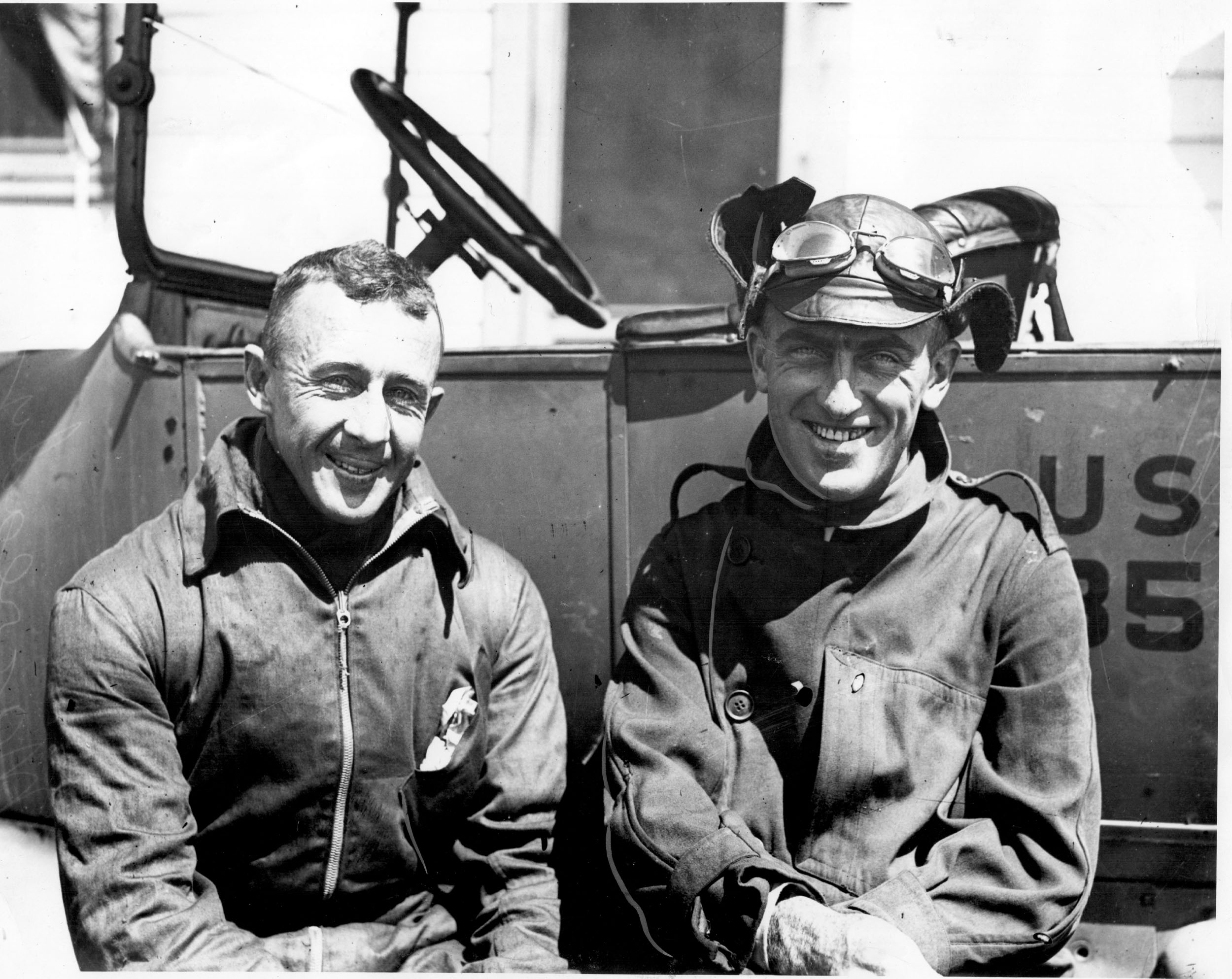
While the battle raged at higher levels airmen, encouraged by Mitchell and others in charge of air service operations, did their best to promote aviation. They patrolled borders, spotted forest fires, flew mail, and broke speed, distance, endurance and altitude records. The idea was to grab headlines and keep aviation before the public – even if it meant answering a challenge to pit an Air Service plane against a platoon of Signal Corps carrier pigeons in a silly match race arranged by a San Francisco newspaper. The airplane won the race but it wasn’t much of a victory for the Air Service.
Kelly and Macready were sure the flight they planned would get better results.
At Rockwell Field, their testing completed, their course all plotted, they practiced flying long hours without sleep. They confided in Harry when they noticed he was spending more time than usual nosing about the base. They said they weren’t thinking of personal glory; it was the future of the Air Service that was important, the need to prove the reliability of the airplane. A laudable sentiment strongly endorsed by Harry – but he knew it was the airmen who were going to get most of the ink.
“Look for a little personal glory,” he told them.
There was little glory in the first attempt on October 5, 1922. The airmen, beaten by high mountains and low fog, a formidable combination in those days, couldn’t get out of California. They poked about seeking a pass through a mountain range north of San Diego and when they couldn’t find it because of the fog they turned back to Rockwell Field and dropped a note saying they would remain aloft and go after the existing endurance record. In truth it was another test flight. They would learn how long they could fly without sleep.
They stayed up for 35 hours and 18 minutes, longer by far than anyone else ever had done. But they hadn’t carried proper recording devices and the record was not accepted. (A later flight over Dayton, Ohio, – and again, it was more of a test – exceeded the time and was officially accepted as a record.)
A second attempt at a nonstop coast-to-coast flight, started November 4, ended in Indianapolis when a water jacket cracked and the engine overheated. The airmen had flown nonstop for 2,060 miles, farther than anyone ever had before but little note was taken of the feat and the airmen themselves were disappointed. They had the plane shipped to New York where they prepared for an east-to-west flight, confident they would make it this time. They would be against the prevailing wind but on a shorter route, and when they got to the coastal mountains the plane would have used up much of its fuel and therefore be substantially lighter. They could zoom right over the mountains. No need to look for a pass.
* * *
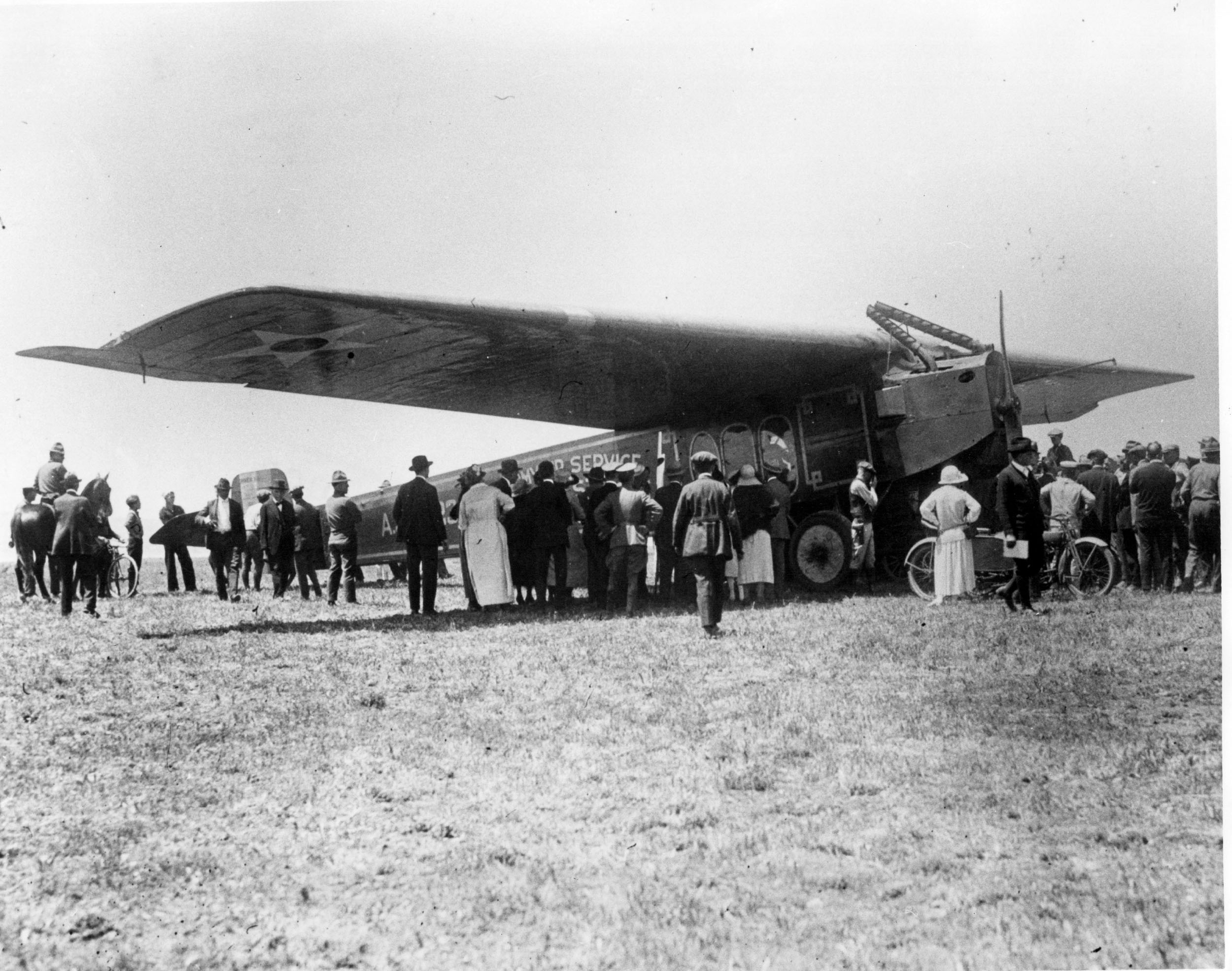
Now it is time to go. Kelly and Macready take their positions. Kelly in front to handle the takeoff, Macready behind in the back-up seat. The wheel locks are removed and Kelly applies full power, but the heavily loaded monoplane refuses to move and a ground crew is summoned to help get it rolling. Crewmen push hard on the wheels and the plane starts to move down the runway. It lumbers along and picks up speed but is still on the ground when it reaches the steep 20-foot drop that leads to Hazelhurst Field. It dips a few feet but recovers and barely maintaining itself in flight skims utility poles and power lines as it lumbers over Long Island, raising itself a foot at a time until it reaches 1,000 feet – and heads for San Diego.
They are 100 miles from Roosevelt Field when they notice the voltage regulator is draining power from the batteries. Unless repaired in an hour or so they will have to the end the flight. They consider the options: land and make the repair and embarrass themselves and the Service – or fix the thing in the air. A tough enough task on the ground, not a chance in this open air cockpit; the engine is next to the pilot, and while making repairs he’ll have to contend with the blast of the wind and the deafening clatter of valves.
But Kelly thinks he can do it and so Macready crawls to the rear controls and pilots the airplane from there. Working in grease and dirt, ignoring the wind and the noise, blowing on fingers to keep them nimble, Kelly dismantles the regulator, carefully resets the points and puts the thing back together. It takes less than thirty minutes – but it seems like a week to Macready who is deep in the tunnel-like fuselage working the back-up controls.
The engine never misses a beat and they continue to San Diego. They follow the railroad tracks and look for the check points they’ve plotted on road maps they’ve pieced together in order (no aerial charts existed back then). They fight the battle in darkness and rain and when morning comes they check their position and proudly proclaim they’ve been able to stay on course. They battle exhaustion by switching positions, and though scary at times, sometimes it’s jolly good fun. They dip to look at volcanic craters, rise to 10,200 feet to cross the Great Divide, and when they finally reach San Diego they swoop down on Broadway and cruise slowly along to give the people a treat, people who wave and shout while sirens are sounding and whistles are blowing.
They cross the bay to North Island and when they touch down to the cheers of the crowd they are assured a footnote in history. They have flown nonstop 2,625 miles across the U.S.A in 26 hours and 50 minutes.
Chief among the dignitaries to greet them is Major Hap Arnold, Rockwell Field commander, who, after praising the flyers seizes the moment to call for further “expansion of aeronautics.”
* * *
Harry made sure his pictures were sent by the photo service he represented to newspapers throughout the country along with the story about the flight. Macready and Kelly got the headlines he’d predicted and the personal glory they said they didn’t want. They also split a $5,000 gift from a retired Air Service colonel who won a bet they would make the flight.
But aviation got a boost too, and the critics and skeptics, if they were fair minded at all, would have to accept the fact the airplane was here to stay. They could no longer proclaim it a mere toy for elite airmen who wanted special privilege and career advancement. They would have to admit it had solid potential for use as a weapon of war as well as for commercial transport.
Harry was happy. Aviation would survive – and so would the guys in the leather jackets and jodhpurs. Some of them, anyway.
* * *
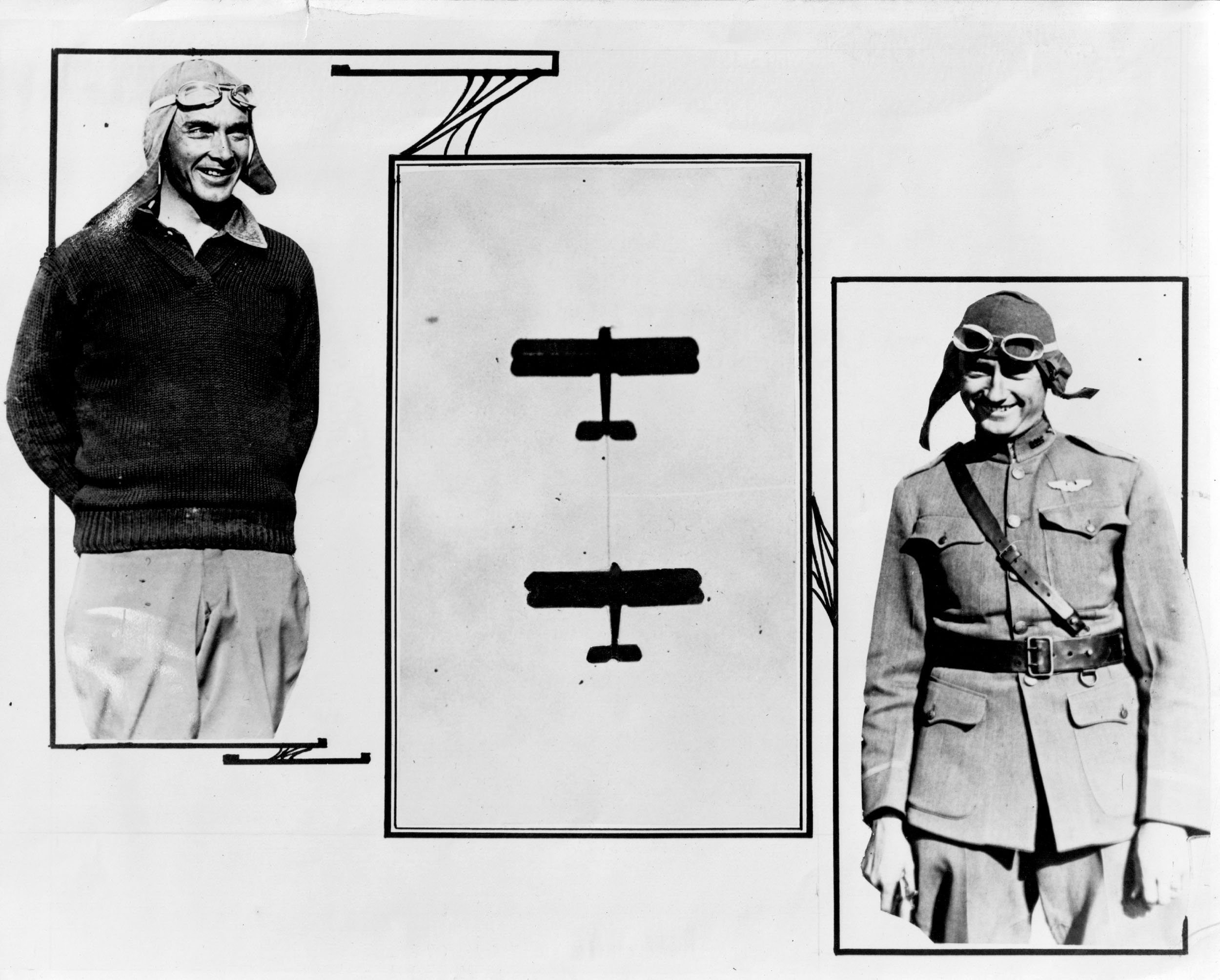
Another Air Service “first” by Rockwell Field fliers, the refueling of a plane in air on June 27, 1923, during an attempt to break an endurance record, got a good press but a snub from the Air Service chief, Arnold’s superior, who called it a circus stunt with no military value – a hasty (or politically motivated) assessment as it turned out, refuted by development and use of refueling techniques for many years to come. Harry was beaten on the pictures when Arnold, who arranged the flight, refused (probably on orders from higher authority) to allow him to fly alongside and photograph the action, and instead, gave the assignment to Navy Chief P.A. McDonough who got the picture Harry wanted. The picture was withheld from the press for reasons known only to the Air Service, but Harry, standing below, waited for the precise moment the planes flew overhead, triggered his camera and got one anyway. Not as good as McDonough’s picture, but with a little tricky art work the presentation in the paper wasn’t bad.
“Best we could do,” Harry said.
* * *
Mitchell, charged with insubordination, court martialed in 1925, found guilty, busted in rank and forced to resign from the Army, continued to argue for air power until he died in 1935 at the age of fifty-six. His ideas were set aside for the most part until they were required to help win a war a few years later. Official recognition was given him in 1946 when President Roosevelt had a special “medal of honor” struck for him.