Having recorded Harry’s achievements it’s time to look at his screw-ups. In dealing with Harry, the matter was not a problem. He freely reported all he remembered and insisted upon their inclusion in any report of his life.
Some of the blunders he mentioned were the kind that amateurs make: cutting the heads off of subjects, making wrong exposures, neglecting to load the camera, exposing film to the light, and messing up in the darkroom. His most embarrassing moments came in 1926 as newly appointed head of the photo and arts department, an appointment he took as an invitation to improve the quality of art in the papers. The opportunity arrived the very first day when among the pictures that came to his desk were two that needed retouching – at least to Harry’s critical eye. One was a head and shoulders shot of a middle aged man who seemed to be lacking eyebrows. The other showed soldiers firing a mid-size cannon that showed no traces of smoke though the recoil had caused the wheels to leave the ground and the soldier who had yanked the lanyard to close his eyes and grimace. Proud of himself for spotting the flaws he ordered the pictures sent to the artist for fixing; and as a result readers that night saw a blast of smoke from a cannon said to be testing smokeless powder and thick eyebrows on a man seeking a sizable settlement for losing them in a fire. After that Harry began reading the captions before passing pictures along, the screw-ups dwindled in number and he ultimately mastered the job. But there were other sins to confess and he insisted on full disclosure. Thus, the Harry depicted in previous chapters – noble newsman battling the enemies of truth and justice – is less apparent in episodes that follow, and a side of him emerges you wouldn’t expect in one who once played chimes for his church and listened to all the sermons. This is not to imply the following reports are daring or deep or dip beneath the trappings. They are offered only to balance the ledger and become a part of the record.
* * *
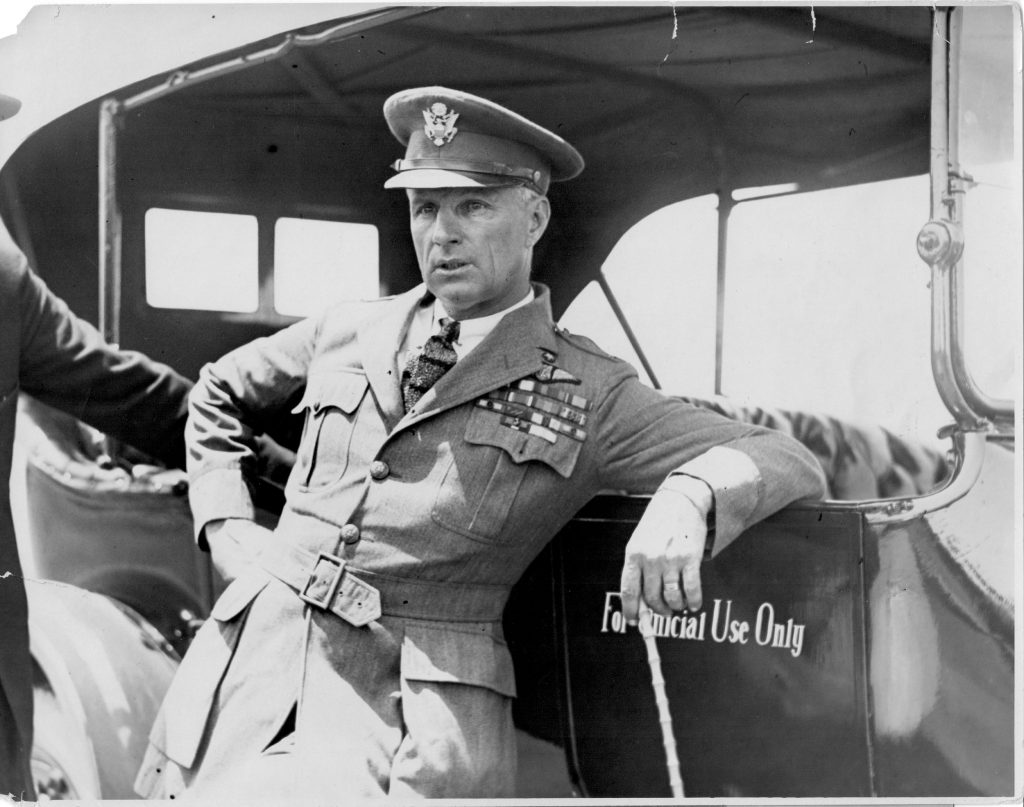
It was a time when the nation, finally convinced that the warlords abroad meant business, had started rearming. The Nazis had conquered Europe and had turned on the USSR, its former partner in crime, and now in the fall of ’41 they were bombing the British Isles and sending hisses across the Atlantic to Americans opposing their conduct. Japan had invaded Manchuria, had marched into China and overrun much of East Asia. Its warlords, while planning to strike Pearl Harbor, were scolding this nation’s leaders for halting the sale of iron and oil and other materials they required for war.
The U.S. was unprepared to say the least, a fact that could be traced to the military cutbacks following World War I. Leaders had shunted aside the warnings of Billy Mitchell and others who during the isolation period had urged the country to keep itself strong, and had opted instead for inertia while indulging the will of the people. Non-interference in European wars had become the cry of the country, so why waste money on arms? Of those endorsing this viewpoint, some kept their arm bands in closets and others their heads in the sand while Hitler ran rampant in Europe and Japan took over East Asia.
The haste to rearm, belated as it was, was a boon to San Diego. Army, Navy, and Marine Corps buildings already in place were being expanded and new ones were going up. Workers were filling the plants where heavy bombers were now in production, related industries were thriving and the long awaited growth of the city was lighting up smiles in boardrooms.
Harry was up on the news. True, he followed his comic page heroes, read their adventures each day, but only after scanning significant stories. And so the invitation to a press tour of the navy base at North Island was no surprise to him. Stories and pictures would show a smoothly functioning Navy base and ease the minds of those made nervous by the fascist salutes they were seeing in Movietone News. That was Harry’s assessment and he had no quarrel with the press tour, though deadly dull it would be.
Security measures had been taken to guard against surreptitious snooping by members of the press, and while the general allotment of armed guards seemed to be one for every five or six newsmen, Harry had his own escort, and a very large one at that; a tribute, he supposed, to his status as a top (or sneaky) news photographer. The significance of the honor did not escape him. He’d photographed every important military event in the area since 1921 and not all of them had been viewed with enthusiasm by the brass.
The welcoming speech by the officer in charge – whose somber eyes were fixed on Harry throughout his harangue – included a warning that unauthorized pictures would not be allowed and that all negatives would be processed and screened before allowed off the base.
Harry got the message. They would get no trouble from him; he wanted to see his nation prepared. He would burn his cameras (except “Old Betsy”) before revealing a national secret. Besides, being called on the carpet was not his idea of fun. Still, as a dedicated newspaperman he would watch for legitimate news, particularly in light of the special treatment he seemed to be getting, which nettled him.
He tagged along on the tour expecting to see just more of the same. He’d visited the place many times starting in 1914 as a reporter for The Sun and later as a photographer for The Union and The Evening Tribune. Growth had been steady but slow, but now there were signs of rapid expansion and increasing activity everywhere on the base; signs not apparent during a visit he’d made just the month before. It seemed to Harry that scores if not hundreds of scouting, bombing, and carrier planes had been added as well as the necessary pilots to fly them and ground mechanics to maintain them. New buildings had gone up, a repair and operating base for aircraft carriers was being expanded, and the number of anti-aircraft gun emplacements had been increased. Officers and men, more than Harry had ever seen on the base before, were scurrying about, some on foot and some in new military vehicles. Harry was impressed; North Island Naval Air Station seemed to be functioning well. But the shots he was given permission to take – new installations and add-ons – would barely interest the public if he was any judge, and midway through the proceedings Harry’s mind went blank and he was tagging along in a trance.
A gust of wind blew his hat from his head and sent it skimming toward the bay. His brand new hat – and he’d thrown the old one away. Holding his camera aloft he pursued the tumbling hat, snatched it from the air, and skidded to a stop. As he clapped it back on his head he saw he was near the shoreline. He also noticed several seaplanes moored near a ramp in the bay, bobbing about in waters choppier than usual. The wind went up a notch in force, the seaplanes continued to bounce, but the picture he automatically framed in his mind, he decided would not be worth the fuss he suspected would follow – his guard had tagged along – and so he rejected the thought of sneaking a shot of the planes. But as he turned to rejoin the group he noticed a seaplane had torn loose from its mooring and, pushed by the wind and helped by the current, had started to drift toward the ramp. He envisioned a minor disaster – and a chance for a pretty good picture, so he readied his old Speed Graphic – (Old Betsy was resting at home) – and waited to see what would happen. A navy boat roared in the distance and soon arrived at the scene bearing six sailors who except for the pilot jumped into the waist-deep water, fixed a line to the seaplane and began pulling with all their might. But the wind was too strong and in spite of their efforts the seaplane continued to drift toward the ramp. Harry envisioned an impact that would rip the seaplane apart; he also envisioned a picture. He tightened his grip on his camera and lifted it to his chest, ready to snap a shot. But the sturdy, young guard beside him grunted a warning and Harry lowered his camera. The sailors were holding on to the line but slipping beneath the waves and slowly losing ground in the battle to save the seaplane. Harry, convinced that the guard, programmed as he was, would not understand that this type of contingency would certainly cancel his orders, decided he’d have to distract the lad – by devious means if need be. He put his camera down and pointing to the struggling seamen, shouted, “Those guys need help! Come on, let’s give them a hand.”
In confessing his crime he said he may have faked a step or two toward the bay – he didn’t remember – but influenced by Harry or not, the guard responded quickly; he laid aside his rifle, ran to the bay, plunged into the water and soon was lending his strength to the effort to save the seaplane. Harry snapped off a couple of shots and watched for something better. The wind became intense. The sailors, though underwater much of the time, managed to stop the drift of the plane, but not the bobbing and weaving. It dipped and rose, and when it all but stood on a wing Harry triggered his camera. He moved in closer and photographed the crewmen as, at last, they pulled the craft to a safe mooring. By that time a crowd had gathered, some to help, some to watch – and one to demand his film. It was an action anticipated by Harry who had hidden the only two holders containing film of the action – a total of four – under his arm, inside his coat. The other holders (with unused film) he handed to the Navy officer who had made the demand….
Standing at the landing at the foot of Broadway, waiting for the “liberty boat” to arrive bearing the sailor he had bribed to smuggle the film ashore, he envisioned the picture he’d framed, the one that would make Page One: the rescue crew waist deep in choppy waters of the bay, struggling desperately to save an obsolete but much needed seaplane. He’d triggered the Speed Graphic at precisely the right time and he could still see the craft standing on a wing. It should be a good action picture but he wondered if he had overstepped the bounds. He finally decided that in plunging ahead guided solely by instinct, getting a picture of heroic sailors battling to save a venerable Navy plane he had upheld the standards of responsible journalism – or at least had come reasonably close. He had stayed within the rules until the unexpected happened and he had been forced to make a decision: submit to the questionable guidelines or get a newsworthy picture. It wasn’t his fault that such a contingency had been overlooked in the Navy guy’s harangue. And there was his duty to the newspaper reading public, not to mention an eager makeup editor. As for the guard he had tricked, he was almost sure the man would have gone to the aid of the crewmen anyway.
And so it was with (almost) a clear conscience that he waited for the sailor he’d bribed to smuggle the film ashore – and waited – wondering “what the dickens” had happened.
“Never saw him again,” he said, “the scamp.”
* * *
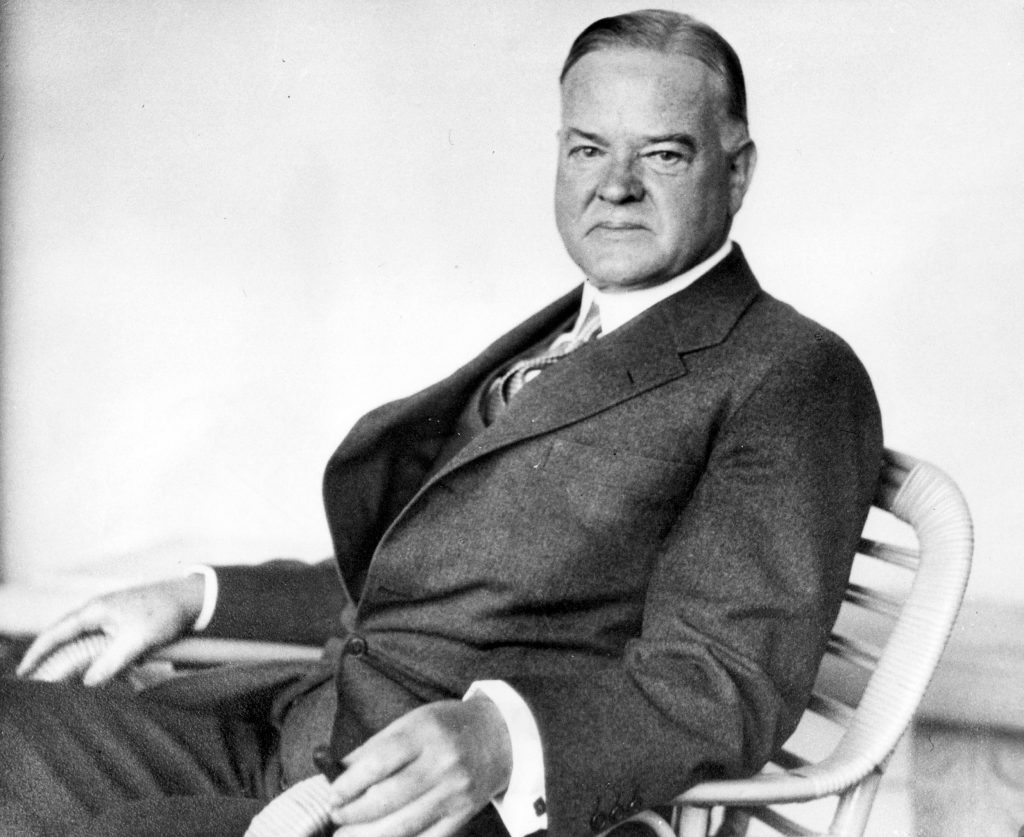
Herbert Hoover was slumped in a wicker chair on the front veranda of the residence of Ira C. Copley, owner (since 1928) of the two newspapers for which Harry worked. One elbow was on an arm of the chair, his chin was on his fist and he was examining the cigar he held with his other hand in front of his face. His eyes were half closed and gave no hint of his thoughts, but if on the somber side it would have been understood. The country he’d been elected to lead five long years ago was in a terrible mess. Though not entirely to blame, he had to take the heat.
Harry, guided by an aide, approached from the side, unnoticed by the preoccupied guest. Struck by the somber scene – dejected President, slumped in sadness, reflecting on the horrors of his country in turmoil – he saw the chance for a human interest shot that would certainly make Page One. Here was the man who had entered the White House in 1928 when the nation was enjoying an unprecedented run of prosperity and who was about to leave it wallowing in the throes of a horrendous depression. On this day, June 21, 1933, when factories were closing, banks were failing, and people were queuing in bread lines, Mr. Hoover was in Coronado, on a veranda, slumped in a wicker chair, smoking a cigar, chin in hand, lost in thought – in the shadow of Harry’s camera. A shot like this could make the history books. Even more important, his photo service would pay him a bonus. No need for a flash gun, not even a tripod; the lighting was perfect. He raised the camera and sighted in. . . . Something made him pause. This was The President, slumped in a chair, looking defeated, certainly not looking his best – and a guest in The Boss’ home –
No matter; the setup was perfect, too good to be missed. He started to trigger the shutter –
“Mr. President,” said the aide, and a startled Herbert Hoover looked up, saw Harry and his camera, and with a trace of a smile on his face as if he knew what Harry was up to, lowered his cigar and straightened in his chair. Then he gazed benevolently at the camera and waited patiently for the home town guy to take his picture.
It was a disgusted Harry Bishop who, cursing himself for blowing the shot, finally triggered the shutter – and got a picture he might have taken in the portrait studio back at the office: a lame duck president posing, pleasantly acquiescent, his eyes no longer sad, just thoughtful. So much for the history books, not to mention the bonus.
Later, he was scolded by the aide for attempting to sneak the shot – and when he got back to his office he was called on the carpet again and asked by a stern faced editor if it was true he had sought to embarrass The President….
* * *
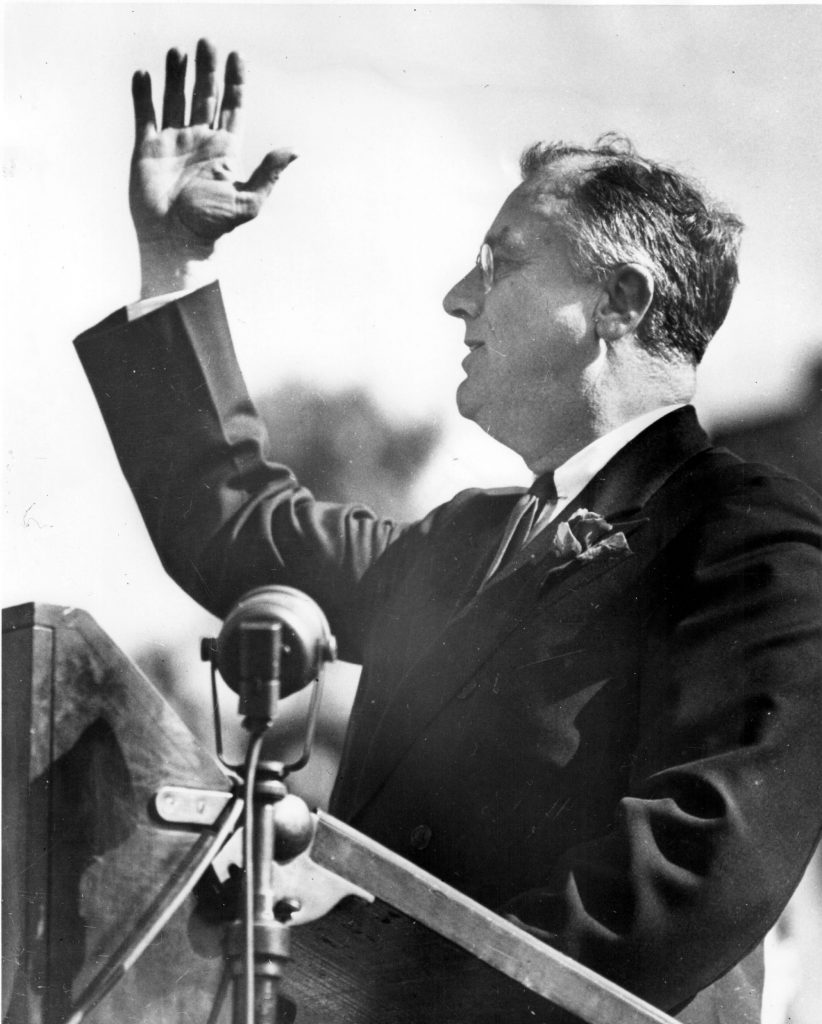
Balboa Stadium was packed that day late in 1933 and the president, Franklin D. Roosevelt, had completed his address to the people of San Diego.
In acknowledging the applause of the crowd, he threw back his head and raised his right hand, and Harry, having declined to join other photographers in front of the speaker’s stand, clicked his camera from the side and got a picture that, at the time, became as widely used as any ever taken of FDR1Although this is no longer the case. The picture, displayed on Page One in the local papers, drew calls from several persons involved in the pseudo science of palmistry asking for blowup pictures of the president’s hand – for study, they said, and in one case for reproduction in a book. Harry’s polite refusal was accepted by all but one of the callers, an articulate, well mannered person whose persistent calls, day after day, soon made him an unbearable pest to members of Harry’s staff.
“What are we going to do?” Harry was asked. “He won’t take no for an answer. . . .”
The copy boy, a lad of sixteen, big for his age, new on the job and eager to please, sat down in the chair, placed his elbow on the table in front of the curtain and straightened his arm; he opened his hand and spread his fingers as directed. It was a good size hand.
“Perfect,” the man with the camera said. “Hold steady now. Good. OK, that’s it. Thanks. One thing. Don’t say anything about this, got it? Absolutely nothing.” The copy boy nodded and left the portrait room, and the photographer went into the photo lab to make a blowup picture.
“I had it ready,” Harry admitted a long time later, “but the guy stopped calling.”